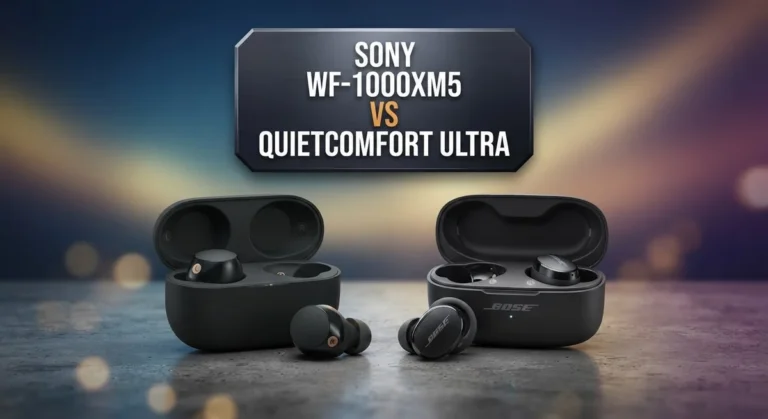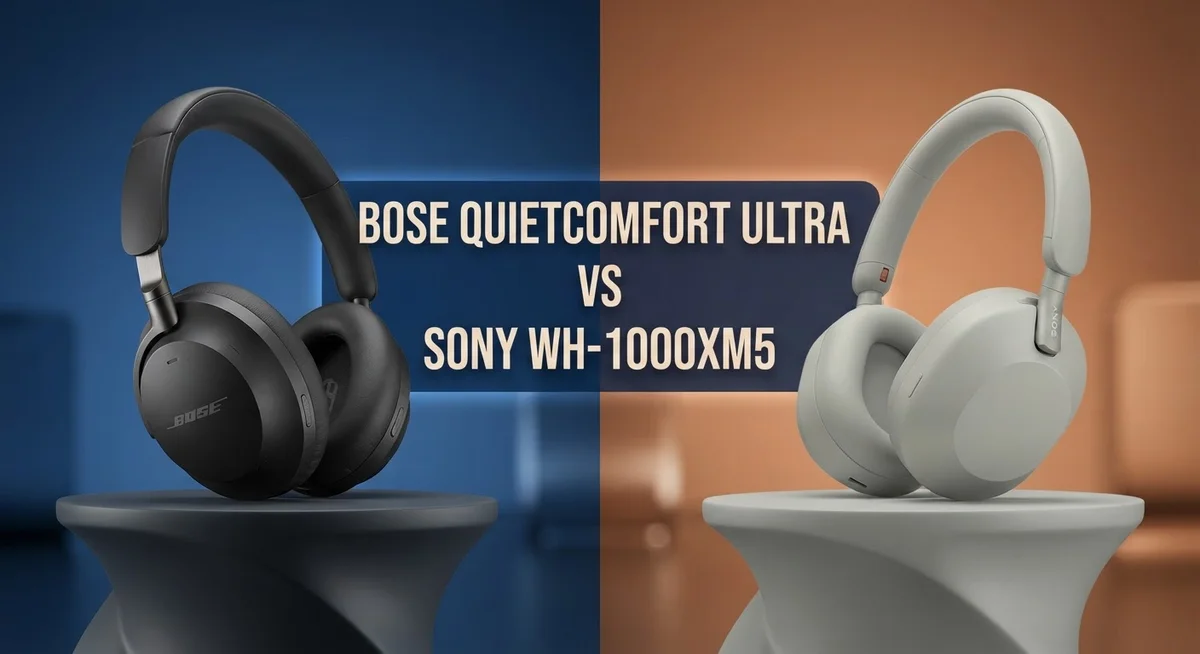
Bose QuietComfort Ultra vs Sony WH-1000XM5: Complete Headphones Comparison
Picking new headphones can feel tricky. Two names always come up: Bose QuietComfort Ultra and Sony WH-1000XM5.
Both promise great noise cancellation. Both aim to make your daily commute or work calls quieter and better.
But they are not the same. Each brand takes a different path to deliver sound and comfort.
Bose focuses on immersive audio and strong noise blocking. Sony leans into a fun sound profile and tough build quality.
So which one fits your ears and your lifestyle better? We break down the specs, the pros, and the cons of each.
By the end, you will know exactly which headphone suits your daily needs. Let us help you unlock the right choice for your ears.
In a Nutshell
Here is a quick summary to help you decide fast.
- Bose QuietComfort Ultra gives you top tier noise cancellation. It blocks outside noise better than most headphones on the market.
- Sound from Bose feels rich and punchy. You get clear audio even in quiet rooms.
- Sony WH-1000XM5 also brings excellent noise cancellation. It keeps up with Bose in most noisy settings.
- Sony offers a fun sound profile. This works great for casual listening sessions.
- Sony headphones have a durable build. They can handle daily wear and tear with ease.
- Bose wins on portability. Its foldable design fits easily into a compact carrying case.
- Sony feels bulkier and less portable than Bose. This matters if you travel often.
- Some listeners find Sony’s soundstage narrow, almost “2D” compared to rivals.
- Bose sound quality edges ahead, but the difference stays marginal for many ears.
Both headphones deliver strong performance. Your final choice depends on what matters most to you: sound depth or rugged durability.
Noise Cancellation Performance
Noise cancellation is where these two headphones truly shine, yet they take different approaches to silence the world around you.
The Bose QuietComfort Ultra delivers superior noise cancellation that feels almost magical. It blocks out low frequency rumble from airplane engines and traffic with impressive efficiency. The active noise cancellation (ANC) adapts smoothly as your environment changes. You get deep, consistent silence that lets you focus on your music or calls. Bose’s algorithm learns your preferences and adjusts the cancellation strength automatically.
The Sony WH-1000XM5 offers excellent noise cancellation that ranks among the best available. Sony’s ANC handles mid and high frequency sounds exceptionally well. Voices and office chatter fade away quickly. The system provides multiple ANC modes so you can customize your listening experience. Sony’s approach feels more responsive to sudden noise changes around you.
Here’s the key difference: Bose edges ahead in overall noise blocking performance. Independent tests show Bose achieves slightly deeper silence, especially in low frequency ranges. For frequent flyers and commuters, this advantage becomes noticeable during long journeys. The Bose cancellation feels more consistent throughout your day.
That said, Sony’s noise cancellation remains impressive for most listeners. The gap between these two narrows significantly in real world use. Office workers and casual commuters may struggle to hear the difference. Sony’s multiple ANC modes give you more control over how much outside sound you want to hear.
Transparency modes on both headphones let you hear ambient sound when needed. Bose’s transparency feels natural and uncolored. Sony’s version works well but sounds slightly more processed to some ears.
Battery life impacts noise cancellation too. Both headphones maintain strong ANC performance throughout their battery life. Neither system weakens as the battery drains, which matters for all day use.
If noise cancellation tops your priority list, Bose wins this round. For most people though, Sony delivers sufficient silence for daily activities. Your choice depends on whether you need maximum noise blocking or simply great noise cancellation that works reliably.

- PREMIUM NOISE CANCELLATION: Two processors control 8 microphones for unprecedented noise...
- MAGNIFICENT SOUND: Engineered to perfection with the new Integrated Processor V1
Last update on 2026-11-11 / Affiliate links / Images from Amazon Product Advertising API
Sound Quality and Audio Profile
The sound quality between these two headphones reveals some interesting differences that matter for different listening habits.
Bose delivers a richer, punchier audio profile that emphasizes warmth and depth. You’ll notice this especially in quiet environments where the clarity really shines. The sound feels more immersive, pulling you into the music with fuller bass and more detailed mids. This makes vocals pop and instruments feel more present around you.
Sony takes a different approach with a fun sound signature that works well for casual listening. The audio leans toward an engaging, lively presentation. However, the soundstage feels narrow and somewhat flat compared to other premium headphones in this class. Many listeners describe Sony’s sound as “2D” rather than three dimensional. This means instruments and vocals don’t spread out as much across the stereo field.
The real question is whether Bose’s advantage justifies your preference. The sound improvement over Sony remains marginal for many ears. If you listen to classical music, jazz, or anything requiring spatial awareness, Bose wins. But if you enjoy pop, hip hop, or electronic music through a fun lens, Sony satisfies just fine.
Codec support matters too. Sony uses LDAC technology, which transmits higher quality audio over Bluetooth. This benefits listeners with compatible devices and high resolution music files. Bose doesn’t offer the same level of codec flexibility, though this rarely impacts everyday listening.
Bass response differs noticeably between them. Bose emphasizes low end punch without muddiness. Sony’s bass feels present but sometimes gets absorbed into the overall mix. Treble handling also separates them. Bose maintains crisp highs without harshness. Sony can sound slightly duller in the upper frequencies.
Your listening environment matters here. In noisy places, both sound good. In quiet spaces, Bose’s clearer audio becomes more obvious. Think about where you spend most listening time. That choice helps guide which sound profile serves you better.
Design, Portability, and Build Quality
When you pick up the Bose QuietComfort Ultra, you notice the foldable design right away. This feature makes it genuinely easy to slip into a bag or backpack. The compact carrying case adds another layer of convenience for travelers and commuters.
The Sony WH-1000XM5 feels solid in your hands, thanks to its durable build quality. Sony engineered these headphones to withstand regular use without falling apart. However, the overall footprint remains larger than the Bose option.
Both headphones weigh surprisingly little, which matters if you wear them for hours. The Bose edges ahead here because the foldable design reduces physical bulk significantly. When you’re moving between locations, this difference becomes noticeable in your bag or carry on luggage.
The build materials on both sets reflect premium construction. Bose uses quality plastics and metals that feel substantial without adding unnecessary weight. Sony’s approach emphasizes durability through reinforced hinges and sturdy components. Neither headphone feels cheap or flimsy.
Portability separates these two more clearly than you might expect. The Bose wins on this front because the foldable design and smaller case make travel simpler. The Sony’s more rigid structure means it occupies more space, which frustrates people who pack light.
Consider your lifestyle when weighing portability. If you commute daily or travel frequently, the Bose’s compact nature offers real advantages. If you mostly use headphones at home or in an office, portability matters less to your decision.
The carrying cases deserve mention too. Bose includes a thoughtful case that protects the headphones while staying slim. Sony’s case works well but takes up more room in your bag.
Both headphones feature quality finishes that resist fingerprints and minor scratches. The materials feel premium without being overly delicate. You won’t worry about damaging them during normal use.
Build quality favors Sony slightly for overall durability and long term reliability. Portability clearly favors Bose for everyday convenience. Your choice depends on whether you prioritize moving your headphones around or keeping them in one place most of the time.
Top 3 Alternatives
Apple AirPods Max

- ULTIMATE OVER-EAR LISTENING EXPERIENCE—Powered by the H2 chip, AirPods Max 2 delivers improved...
- TUNE OUT THE NOISE—Up to 1.5x more Active Noise Cancellation than the previous generation, fully...

Last update on 2026-11-10 / Affiliate links / Images from Amazon Product Advertising API
Apple AirPods Max deliver premium sound quality with spatial audio support. These headphones feature active noise cancellation that adapts to your environment automatically. The transparent mode lets you hear the world around you without removing them.
Battery life reaches 20 hours with ANC enabled. You get seamless integration across Apple devices through automatic switching. The digital crown gives you intuitive control over volume and playback. The design feels luxurious with aluminum and mesh construction.
Sennheiser Momentum 4

- Seamless Firmware & App Updates: Enjoy a smoother, more reliable experience with the latest firmware...
- Audiophile-Inspired Sound : Sennheiser wireless headphones over ear with Signature Sound, 42mm...
Last update on 2026-11-10 / Affiliate links / Images from Amazon Product Advertising API
Sennheiser Momentum 4 headphones stand out for their exceptional battery performance. You get 60 hours of listening time on a single charge. The active noise cancellation adjusts to your surroundings in real time.
These headphones offer personalized sound through an app-based equalizer. The build quality feels solid with premium materials throughout. Comfort comes from memory foam ear cups that mold to your head. The sound signature emphasizes clarity and detail across all frequencies.
JBL Tour One

- The wireless Tour One M2 Bluetooth headphones with impressive JBL Pro Sound isolate noise thanks to...
- The JBL Spatial Sound delivers a spatial sound experience while the Personi-Fi function allows the...
Last update on 2026-11-10 / Affiliate links / Images from Amazon Product Advertising API
JBL Tour One headphones combine style with strong noise cancellation capabilities. The adaptive ANC technology responds to your environment automatically. Touch controls on the ear cups let you manage music and calls easily.
Battery life extends to 50 hours in normal mode. The sound profile leans toward bass-heavy, making them great for music lovers. Comfort features include adjustable headband and soft ear cushions. These headphones work well across different devices and platforms without any ecosystem restrictions.
Connectivity and Codec Support
When you connect these headphones to your devices, the experience differs in meaningful ways. The Sony WH-1000XM5 uses Bluetooth 5.2 technology, which provides a stable and fast connection across your phone, tablet, or computer. This newer Bluetooth standard means fewer dropouts and better range when you move around your home or office.
The Sony supports three audio codecs: SBC, AAC, and LDAC. LDAC is the standout feature here. It transmits high quality audio over Bluetooth at much higher bitrates than standard connections. If your phone or music player supports LDAC, you’ll notice clearer details in your music and a more refined listening experience.
The Bose QuietComfort Ultra takes a different approach to connectivity. While specific codec details weren’t emphasized in the research, Bose focuses on reliable, seamless pairing with your devices. The connection feels intuitive and rarely requires troubleshooting once you set it up initially.
Multipoint connectivity matters for many users. Both headphones let you connect to multiple devices simultaneously. You can switch between your phone and laptop without manually disconnecting and reconnecting. This feature saves time during your workday or when you move between personal and professional devices.
Latency is worth considering if you watch videos or play games. Sony’s Bluetooth 5.2 typically handles low latency modes better than previous generations. The Bose performs well too, though the Sony edges ahead for video syncing and gaming applications.
Stability in crowded wireless environments favors the Sony slightly. Bluetooth 5.2 handles interference better when you’re surrounded by other wireless devices. In a typical home or office, both headphones maintain solid connections without issues.
Pairing speed differs subtly between them. The Sony reconnects to previously paired devices almost instantly. The Bose also reconnects quickly, though some users report slightly longer initial pairing sequences. Neither headphone creates frustration during connection processes.
The real difference emerges when audio quality matters most. Sony’s LDAC codec support gives it an advantage for audiophiles and music enthusiasts who use compatible devices. The Bose offers simpler, more straightforward connectivity without codec complexity.
Comfort and Wearability
When you wear the Bose QuietComfort Ultra for extended periods, the fit feels secure and comfortable. The ear cups provide soft padding that doesn’t create pressure points. Your ears stay cool because the materials allow decent airflow.
The Sony WH-1000XM5 also delivers solid comfort during long listening sessions. The cushioning feels plush and wraps around your ears gently. Many users report wearing them for 8+ hours without discomfort.
Headband tension matters more than people realize. The Bose model has a well-balanced headband that distributes weight evenly across your head. The Sony’s headband feels slightly firmer, which some find secure and others find restrictive over time.
Weight plays a key role in wearability. Both headphones are light enough for all-day use. The Bose weighs just enough to feel substantial without fatigue. The Sony matches this lightness, so neither wins on this factor alone.
The ear cup design differs between them. Bose uses a more compact shape that fits various ear sizes well. Sony’s larger ear cups work better if you have bigger ears, but might feel loose on smaller ears. Your personal ear anatomy determines which feels better for you.
Sweat resistance and material durability affect long term comfort. The Bose materials hold up well during workouts and humid conditions. The Sony’s build quality resists wear, though the padding can compress after years of use.
Clamping force impacts how the headphones feel during movement. The Bose holds firmly without feeling too tight. The Sony’s grip feels stronger, which some prefer for stability during exercise.
Temperature regulation matters during extended wear. The Bose ear cups breathe reasonably well. The Sony’s padding can trap heat slightly more, making ears feel warmer after 3+ hours of continuous use.
The carrying case affects portability comfort too. The Bose’s compact case fits easily into bags and backpacks. The Sony’s case is slightly bulkier but offers more protection. Both cases make carrying these headphones convenient for travel.
Overall, comfort depends on your head shape and personal preferences. Try both models if possible to see which feels right for your ears.
Pros and Cons
Pros
- Bose delivers superior noise cancellation that blocks out more background sound than Sony
- Bose produces richer and punchier audio that sounds more dynamic in quiet spaces
- Sony offers a fun sound profile that works well for casual listening and everyday use
- Sony builds these headphones with exceptional durability that withstands regular wear
- Bose folds up compactly, making it easier to slip into bags and travel with
Cons
- Bose’s sound improvement over Sony feels marginal in real world listening situations
- Sony has a narrow soundstage that makes the audio feel flat and two dimensional
- Sony takes up more space due to its bulkier design, reducing portability compared to Bose
Who Should Buy It
The Bose QuietComfort Ultra suits you best if noise cancellation is your top priority. You want headphones that block out more sound than competitors. This model excels when you work in noisy offices or travel frequently. The superior sound quality matters to you in quiet environments. You appreciate richer, punchier audio that feels dynamic and alive.
Choose the Bose if portability ranks high on your list. The foldable design and compact carrying case make travel simple. You slip these into your bag without much hassle. The lighter weight reduces fatigue during all day wear.
The Sony WH-1000XM5 fits your needs if you prefer a fun sound profile. You listen to music casually and want something enjoyable rather than analytical. These headphones deliver solid entertainment for everyday listening. You don’t need the absolute best noise cancellation available.
Pick the Sony if durability matters most to you. These headphones withstand regular wear and tear. You want something built to last through years of use. You don’t mind a bulkier design in exchange for toughness.
The Sony also works well if you use multiple devices constantly. The multipoint connectivity lets you switch between phone, tablet, and computer seamlessly. You value smooth transitions between your gadgets.
Choose the Bose if you’re an audiophile or serious music listener. You notice subtle differences in sound quality. You spend extended time in quiet spaces where audio clarity shines. You want headphones that reveal details in your favorite tracks.
The Sony appeals to casual users who prioritize comfort and reliability. You don’t analyze sound quality deeply. You just want headphones that work well without complications. You appreciate a straightforward listening experience.
Both options suit different people. Think about your main use case first. Do you commute daily? Travel often? Work in loud spaces? Listen critically to music? Your answers determine which headphones serve you better. Neither choice is wrong. Your lifestyle and listening habits guide the decision.
Final Verdict
Choosing between these two headphones comes down to your daily habits and listening style. Both models excel in their own way, but your final pick depends on what matters most to you.
If you travel often, the Bose QuietComfort Ultra fits your lifestyle better. Its compact design slips into carry on bags without hassle.
Frequent flyers and commuters often prefer Bose for this reason alone. Space matters when you pack light.
For remote workers who join video calls all day, both headphones handle voice clarity well. Sony’s mic array picks up speech clearly in quiet rooms.
Bose also handles calls confidently, especially in windy or noisy outdoor settings. Its voice pickup stays steady even when background noise increases.
Gamers who value low latency might lean toward Sony, since it pairs smoothly with multiple devices at once. This helps when switching between a laptop and phone during work breaks.
Bose feels like the smarter pick for serious listeners who want immersive sound and strong isolation. Sony still holds its ground for people who want dependable performance without fuss.
Think about how you use headphones daily. Do you switch between devices constantly? Sony supports that better.
Do you prioritize sound quality above all else? Bose wins that argument clearly.
Neither headphone disappoints, but your personal priorities decide the winner. Consider testing both if you get the chance before deciding.
If you want alternatives outside this comparison, the Sony WH-1000XM6 and Sennheiser Momentum 4 offer strong competition. The Apple AirPods Max 2 and Bowers & Wilkins PX7 S2e also deserve a look if you want different sound signatures.
In the end, both the Bose QuietComfort Ultra and Sony WH-1000XM5 earn their reputation as top tier headphones. Your final decision should match your listening habits, travel needs, and daily routine rather than following trends.
Frequently Asked Questions
Which headphones work better for frequent travelers?
The Bose QuietComfort Ultra edges ahead for travelers. It folds into a compact shape and comes with a carrying case designed for easy packing. You slip it into bags without taking up much space. The Sony sits bulkier in comparison, making it less convenient for trips where luggage space matters.
If you fly often or commute regularly, Bose’s portability becomes a real advantage. You won’t feel weighed down by your gear.
Do these headphones handle video calls well?
Both models perform strongly during calls. They pick up your voice clearly and filter out background noise effectively.
The Bose QuietComfort Ultra excels in windy or loud outdoor settings. It isolates your voice better when you’re in challenging environments. The Sony WH-1000XM5 also handles calls confidently indoors and in normal conditions. Choose Bose if you take calls in unpredictable outdoor spaces.
Which is better for casual listening versus serious music fans?
The Sony WH-1000XM5 suits casual listeners perfectly. Its fun sound profile works great for everyday music, podcasts, and streaming content. You get enjoyable audio without overthinking it.
The Bose QuietComfort Ultra appeals to serious music listeners. It produces richer, punchier sound that reveals more detail in your favorite songs. Audiophiles notice the difference in quiet spaces. Bose brings out textures and dynamics that casual listeners might miss.
Can you use these with multiple devices at once?
The Sony WH-1000XM5 pairs smoothly with multiple devices. You switch between your phone, laptop, and tablet without friction. This feature makes Sony ideal if you juggle several gadgets throughout your day.
The Bose QuietComfort Ultra connects reliably too, but Sony handles device switching with slightly more ease. Pick Sony if you constantly move between different screens.

Dillip is the founder and editor of ImageScaleLab.com, a passionate tech enthusiast who loves breaking down complex gadgets and accessories into simple, honest reviews and buying guides. With years of hands-on experience exploring the latest in tech, he is dedicated to helping readers make smarter, more confident purchasing decisions.