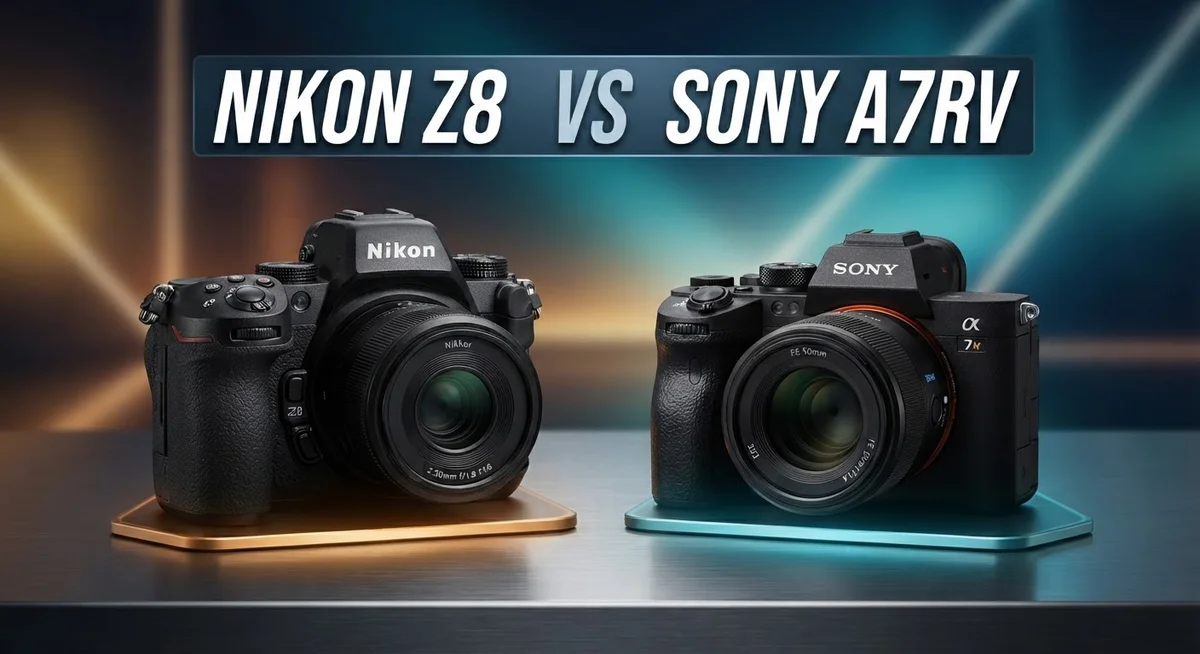
Nikon Z8 vs Sony A7RV: Professional Mirrorless Camera Comparison
Choosing a camera can feel tricky. The Nikon Z8 and Sony A7RV are two giants in this space.
Both cameras pack serious power. But they shine in different ways.
The Z8 brings speed to the table. It offers a fast frame rate and zero viewfinder blackout. This makes it great for action shots.
The A7RV focuses on detail. It packs more autofocus points and higher resolution. Studio shooters will love this precision.
So which one fits your style? Sports and wedding photographers often lean toward the Z8. Its hybrid skills handle motion with ease.
Meanwhile, studio and portrait artists may prefer the A7RV. Its sharp resolution captures fine details beautifully.
This guide breaks down every key feature. We compare autofocus, speed, and lens options side by side. By the end, you will know exactly which camera suits your creative needs.
In a Nutshell
Here’s the quick lowdown before you decide:
-
The Z8 offers 493 autofocus points and shoots with no viewfinder blackout. This means your subject stays visible even during continuous shooting.
-
The A7RV steps up with 693 autofocus points. More points mean better subject tracking in tricky scenes.
-
Resolution favors the A7RV. It captures finer detail, perfect for large prints or heavy cropping.
-
Speed favors the Z8. Faster processing helps you capture fast action without missing a beat.
-
Lens choices differ too. The A7RV taps into a wider lens ecosystem across various price points. The Z8 has fewer options right now.
-
Thinking about video work? The Z8 shines here with its hybrid capability. Photographers who shoot both stills and video often find this handy.
-
Want another option? The Canon EOS R5 II also competes in this space. It’s worth a look if neither Nikon nor Sony feels quite right.
Both cameras deliver strong results. Your final choice depends on what you shoot most.
Autofocus System and Performance
The autofocus systems in these two cameras take different approaches. The Nikon Z8 uses 493 autofocus points with a hybrid phase and contrast detection setup. The Sony A7RV counters with 693 points across its full frame sensor.
More autofocus points sound better on paper. The A7RV’s extra coverage helps when subjects move unpredictably across your frame. You get faster tracking in chaotic scenes like crowded weddings or wildlife situations.
However, point count tells only part of the story. The Z8 excels at speed and responsiveness. Its processor handles focus calculations faster than the A7RV. This means quicker lock-on times and smoother continuous shooting. The Z8 reaches 12 frames per second with full autofocus tracking. The A7RV manages 10 frames per second, which still impresses but feels slightly slower.
The Z8’s no viewfinder blackout feature changes the game for fast action. You never lose sight of your subject between frames. The A7RV uses a traditional electronic viewfinder that briefly blacks out during burst shooting. For sports photographers, this difference matters significantly.
Both cameras handle low light well. The Z8 focuses down to minus 4.3 EV. The A7RV reaches minus 4 EV. Real world performance feels similar in dim conditions, though the Z8 edges ahead slightly.
Eye and face detection works on both systems. The Z8 adds animal eye detection too, which helps wildlife shooters. The A7RV focuses more on human subjects but does this exceptionally well.
For fast paced work, the Z8 feels snappier and more reactive. For stationary subjects or studio setups, the A7RV’s extra focus points provide unnecessary but welcome coverage.
Your shooting style matters most here. Choose the Z8 if you chase moving subjects constantly. Pick the A7RV if you value having maximum flexibility across varied scenarios. Neither camera disappoints with autofocus performance. They just prioritize different strengths.

- 45.7MP stacked CMOS sensor and EXPEED 7 processing engine.
- Nikon’s most advanced autofocus system. AF algorithm developed using deep learning technology...

Last update on 2026-11-08 / Affiliate links / Images from Amazon Product Advertising API
Sensor Resolution and Image Quality
Sensor resolution and image quality form the foundation of any camera choice. Let’s explore how these two powerhouses compare in this critical area.
The A7RV delivers higher resolution output. Its sensor captures more megapixels, which means you get exceptional detail in your final images. This advantage shines when you print large format photos or crop heavily in post production. Studio photographers and those working with high resolution requirements will notice the difference immediately.
The Z8 takes a different approach. It prioritizes speed and processing power over raw megapixel count. Its sensor still produces excellent image quality, but it focuses on real time performance. This means faster buffer clearing, quicker file writing, and smoother shooting sequences during demanding sessions.
Both cameras excel in low light situations. Their sensors handle high ISO values without excessive noise. You can shoot confidently in dim environments without losing image quality. This capability matters for wedding photographers, event shooters, and anyone working indoors.
Color accuracy and dynamic range are strong points for both. The A7RV captures slightly more tonal information due to its resolution advantage. The Z8 maintains excellent color science while delivering faster overall workflow. Neither camera disappoints when it comes to rendering colors naturally.
Sensor cleaning technology differs between them. Both systems offer effective dust removal features. Your choice here won’t significantly impact daily shooting unless you work in extremely dusty environments.
The real difference lies in your intended use. Choose the A7RV if you need maximum resolution for billboard sized prints or extensive cropping flexibility. Select the Z8 if you shoot fast moving subjects where speed and responsiveness matter more than absolute pixel count.
Neither sensor produces poor quality images. The gap between them is meaningful but not dramatic. Modern editing software can compensate for resolution differences in many situations. Your lens selection and shooting technique often influence final image quality more than the sensor alone.
Consider your typical shooting scenarios. High resolution work demands the A7RV. Speed focused photography favors the Z8. Most photographers find either sensor more than sufficient for professional and personal projects.
Shooting Speed and Operational Efficiency
When it comes to shooting speed, the Z8 operates in a league of its own. This camera fires at a faster frame rate, making it ideal for photographers who need to capture rapid sequences without missing the decisive moment.
The A7RV takes a more measured approach. Its processing speed feels slower during burst shooting, which can affect your workflow during fast paced events. If you shoot sports or weddings regularly, you’ll notice this difference immediately.
The Z8’s no viewfinder blackout feature deserves special attention. While you shoot, the viewfinder stays live and active. You never lose sight of your subject between frames. The A7RV uses a traditional electronic viewfinder, which means brief blackouts occur during continuous shooting. This gap matters when tracking moving subjects.
Autofocus responsiveness differs between these cameras. The Z8 feels snappier and more reactive to subject movement. Its 493 points work together efficiently to lock onto targets quickly. The A7RV’s 693 autofocus points offer more coverage across the frame, but this doesn’t necessarily translate to faster operation. More points can sometimes create processing delays.
Both cameras handle continuous autofocus tracking effectively. Eye and face detection works smoothly on each system. However, the Z8’s hybrid autofocus technology gives it an edge in unpredictable shooting situations.
Buffer capacity also plays a role in operational efficiency. The Z8 clears its buffer faster between burst sequences. This means less downtime waiting for the camera to process images. The A7RV requires longer intervals between rapid fire shooting sessions.
For video work, the Z8 demonstrates superior operational efficiency. Its hybrid capability allows seamless transitions between stills and motion. The camera handles frame rates and codecs without stumbling.
If your primary focus involves studio work or high resolution output, the A7RV’s operational pace feels less restrictive. You’re not constantly pushing burst speeds or tracking moving subjects. The camera’s processing speed matters less in controlled environments.
Choose based on your actual shooting scenarios. Fast paced action demands the Z8’s speed advantage. Deliberate, controlled shooting suits the A7RV equally well.
Top 3 Alternatives
Canon EOS R5

- Canon USA Authorized. Items Include: Canon EOS R5 Mirrorless Camera – 45MP Full-Frame RF Camera...
- 45MP Full-Frame Sensor: Delivering incredible resolution, the R5 is perfect for landscape, portrait...
Last update on 2026-11-08 / Affiliate links / Images from Amazon Product Advertising API
The Canon EOS R5 brings professional-grade performance to photographers who want reliability and speed. This camera features a 45-megapixel sensor that captures incredible detail in every shot. You get fast autofocus with 1,053 focus points across the entire frame.
The R5 shoots 4K video at 120fps, making it excellent for content creators. Its build quality feels solid and weather-sealed for outdoor work. Battery life lasts through full shooting days without constant charging.
Sony A7R V

- SONY USA AUTHORIZED - Includes Full SONY USA WARRANTY, Camera Package Includes Camera Body...
- Sony a7R V Mirrorless Camera : 61MP Full-Frame Exmor R BSI CMOS Sensor, AI-Based Real-Time Tracking...
Last update on 2026-11-08 / Affiliate links / Images from Amazon Product Advertising API
The Sony A7R V represents cutting-edge imaging technology with a 61-megapixel sensor. This camera delivers exceptional resolution for large prints and detailed crops. The autofocus system uses AI to track subjects with remarkable accuracy.
You’ll appreciate the compact body design that doesn’t sacrifice functionality. The electronic viewfinder updates smoothly, giving you real-time exposure previews. Sony’s lens ecosystem offers diverse options for different creative needs.
Nikon Z9

- 45.7MP Stacked CMOS sensor and EXPEED 7 image processing. Fast powerful AF that can keep up with the...
- Subject detection uses deep learning to automatically detect and track people, cats, dogs, birds...
Last update on 2026-11-08 / Affiliate links / Images from Amazon Product Advertising API
The Nikon Z9 combines speed and image quality in one powerful package. It shoots at 11fps with full autofocus tracking, perfect for fast-action photography. The 45.7-megapixel sensor produces clean images even at high ISO settings.
This camera handles demanding situations with its robust construction and dual card slots. The Z9 processes images quickly, so you spend less time waiting between shots. Its ergonomic design feels comfortable during extended shooting sessions, and the weather-sealed body performs reliably in challenging conditions.
Lens Ecosystem and Compatibility
Nikon’s Z mount ecosystem and Sony’s E mount ecosystem represent two distinct approaches to lens availability and compatibility. Each system offers unique advantages depending on your shooting needs.
The Nikon Z8 works with Nikon’s Z mount lenses. This system has grown significantly in recent years. Nikon offers a solid range of native lenses for professional work. The Z mount includes fast primes, versatile zooms, and specialized optics for different genres.
Sony’s E mount ecosystem is substantially larger. The A7RV accesses native Sony lenses plus third party options from Sigma, Tamron, and others. This gives you more choices at different price points. You’ll find budget friendly options alongside premium glass.
Compatibility extends beyond native lenses. The Z8 can use older Nikon F mount lenses with an adapter. This opens access to decades of Nikon glass. Sony shooters also benefit from extensive adapter support for legacy lenses.
The key difference lies in ecosystem maturity. Sony’s E mount arrived earlier and attracted more manufacturers. You’ll discover more variety in focal lengths and lens types. Nikon’s Z mount is newer but growing rapidly with professional grade options.
For specialized work, consider your specific needs. Wedding photographers find excellent options in both systems. Landscape shooters will appreciate the lens variety available. Sports photographers get strong autofocus tracking in both lineups.
Lens rental availability matters too. Major rental houses stock both systems extensively. You can test different lenses before purchasing. This flexibility helps you build your kit strategically.
Future lens development favors both systems. Nikon continues expanding Z mount offerings. Sony maintains momentum with E mount releases. Neither ecosystem will limit your creative options long term.
The real question is simple: which lenses do you already own? If you have existing glass, that often determines your camera choice. Starting fresh? Both systems provide everything you need for professional results. Your preferred focal lengths and shooting style should guide your lens ecosystem decision more than anything else.
Video Capabilities and Hybrid Features
The Nikon Z8 and Sony A7RV take different approaches to video and hybrid shooting. Understanding these differences helps you pick the right camera for your creative needs.
The Z8 excels at video recording with its advanced processing engine. This camera handles 8K video capture smoothly. The no viewfinder blackout feature proves invaluable during video work. You see your subject continuously without interruption. This matters when you’re monitoring exposure and composition in real time.
Sony’s A7RV offers solid video capabilities too. It records in 4K with excellent quality. The higher autofocus point count (693 vs 493) helps track moving subjects during video. This becomes useful when filming interviews or dynamic scenes.
Frame rates differ between these cameras. The Z8 captures footage at faster speeds. This advantage shows when you need slow motion playback. Fast paced action looks smooth and cinematic on the Z8.
Hybrid shooters should note the operational differences. The Z8’s faster processing means quicker file handling. You move between photo and video modes without delays. The A7RV operates at a slower pace. Switching between modes takes longer. For wedding videographers who also shoot stills, the Z8 workflow feels more efficient.
Autofocus during video matters significantly. The A7RV’s superior autofocus system tracks subjects with precision. The Z8 also performs well here. Both cameras maintain focus during movement. Your choice depends on how often you need to track fast moving subjects.
Color science differs between manufacturers. Nikon’s Z8 delivers warm, natural skin tones. Sony’s A7RV produces cooler, more clinical colors. Many videographers prefer Nikon’s color rendering straight from the camera. This reduces grading time in post production.
Buffer capacity affects video recording too. The Z8 handles longer continuous recording sessions. The A7RV requires occasional pauses. For event videography, the Z8’s sustained performance wins.
Choose the Z8 if video is your primary focus. Its speed, color science, and no blackout feature create a superior experience. Pick the A7RV if you need high resolution stills alongside occasional video work.
Pros and Cons
Pros
- Z8 captures 20 frames per second with no viewfinder blackout, making fast action shooting seamless
- A7RV delivers 693 autofocus points versus Z8’s 493, giving Sony users superior focus precision in complex scenes
- Z8’s hybrid capability handles both stills and video at professional levels without compromise
- A7RV offers higher resolution output, ideal for studio work and large format printing
- Sony’s E mount ecosystem provides more lens choices at different price ranges compared to Nikon’s Z mount selection
Cons
- Z8 has fewer autofocus points, which can limit tracking performance in unpredictable situations
- A7RV operates slower overall, making it less suitable for fast paced wedding or sports photography
- Nikon’s Z mount lens library remains smaller than Sony’s established E mount collection, limiting your options
Who Should Buy It
Sports photographers and videographers should strongly consider the Nikon Z8. Its 20 frames per second with zero viewfinder blackout means you never miss the decisive moment. Fast action demands instant feedback, and the Z8 delivers exactly that.
Wedding photographers face a different choice. The Z8 handles both photography and video without switching cameras. You can shoot the ceremony in stills mode, then transition to video for the reception. This hybrid flexibility saves time and reduces gear weight.
Studio and commercial photographers who prioritize resolution should lean toward the Sony A7RV. Its higher megapixel count lets you crop aggressively in post-production. Large format printing also benefits from extra resolution. If your clients demand massive wall prints, Sony’s output gives you more options.
Photographers working in unpredictable lighting or complex scenes benefit from Sony’s 693 autofocus points. The A7RV tracks subjects more reliably when conditions shift rapidly. Wildlife photographers especially appreciate this advantage during chaotic moments.
If you already own Nikon glass, the Z8 becomes the obvious choice. Your existing lenses work seamlessly with the Z mount system. Switching ecosystems means replacing your entire lens collection, which doesn’t make financial sense.
Conversely, Sony users with an E mount collection should stick with the A7RV. Your investment in lenses continues to work. Ecosystem lock-in matters more than you might think.
Travel photographers should consider camera weight and size. Both cameras are professional tools, but the Z8 feels slightly more compact. Lighter gear means less fatigue over long shooting days.
Content creators who blend photography and video prefer the Z8’s processing engine. Its advanced hybrid features handle both mediums at professional quality. The A7RV does video well, but the Z8 was built for creators who refuse to compromise.
Budget-conscious professionals should evaluate lens costs separately. Sony’s E mount offers more affordable third-party options. Nikon’s Z mount ecosystem costs more per lens overall.
Your primary shooting style determines the best choice. Fast action shooters and hybrid professionals gravitate toward the Z8. High-resolution specialists and studio workers prefer the A7RV. Neither camera is wrong. Your specific needs make one clearly better than the other.
Final Verdict
Picking between these two cameras comes down to your shooting style. Both models deliver professional results. Your final choice depends on what you shoot most often.
The Nikon Z8 shines for action and motion. It suits photographers who need speed and reliable video output in one body.
The Sony A7RV stands out for detail and precision. It fits creators who value sharp images over rapid burst shooting.
Think about your current gear too. Switching camera systems means new lenses and new accessories. Staying with your existing mount saves time and effort.
Consider your creative goals as well. Some photographers chase movement and energy. Others chase clarity and fine detail in every frame.
Neither camera is a bad pick. Each one excels in its own lane. The right choice simply matches your specific needs.
If you shoot weddings, sports, or fast events, the Z8 fits better. Its design handles quick moments without missing a beat.
If you shoot portraits, products, or landscapes, the A7RV fits better. Its resolution captures fine textures that matter in still subjects.
Competitors like the Canon EOS R5 II also deserve a glance. But between these two, the decision stays simple once you know your priorities.
Test both cameras if you can. Handling each body helps you feel the difference in grip and control layout.
Talk to other photographers in your field. Their real world experience often reveals small details that specs cannot show.
In the end, trust your shooting habits. The camera that matches your daily workflow will always feel like the better choice.
Both the Nikon Z8 and Sony A7RV represent top tier engineering. Your final decision should reflect your personal style, not just the numbers on a spec sheet.
Frequently Asked Questions
Which camera has better autofocus for wildlife photography?
The Sony A7RV takes the lead here with 693 autofocus points compared to the Z8’s 493. This extra coverage helps you track unpredictable animal movement across the frame. Sony’s system excels when subjects move erratically or appear in frame edges.
The Nikon Z8 still performs well for wildlife work. Its autofocus is responsive and accurate. However, the fewer points mean you have less flexibility in complex scenes with multiple animals or busy backgrounds.
Can I use my existing lenses on either camera?
This depends on what you already own. If you have Nikon F mount glass, the Z8 works with an FTZ adapter. You lose some autofocus speed with adapted lenses, but compatibility exists.
Sony E mount users have a huge advantage with the A7RV. Native E mount lenses work perfectly without adapters. Sony also offers more lens options at different price points, so you have more flexibility building your kit.
Which camera is faster for continuous shooting?
The Nikon Z8 wins on speed. It captures more frames per second and has no viewfinder blackout during shooting. This matters for sports and fast events where you need rapid-fire sequences.
The Sony A7RV operates more slowly. It works fine for most photography, but fast paced action requires patience and timing.
Should I choose based on resolution alone?
No. The Sony A7RV offers higher resolution, which helps for large prints and studio work. But resolution isn’t everything.
The Nikon Z8 handles video and hybrid workflows better. Its processing engine gives you flexibility for content creation. Choose based on your actual shooting needs, not specs alone.

Dillip is the founder and editor of ImageScaleLab.com, a passionate tech enthusiast who loves breaking down complex gadgets and accessories into simple, honest reviews and buying guides. With years of hands-on experience exploring the latest in tech, he is dedicated to helping readers make smarter, more confident purchasing decisions.