Sony RX100 vs Canon G7X: Complete Comparison Guide for Compact Camera Buyers
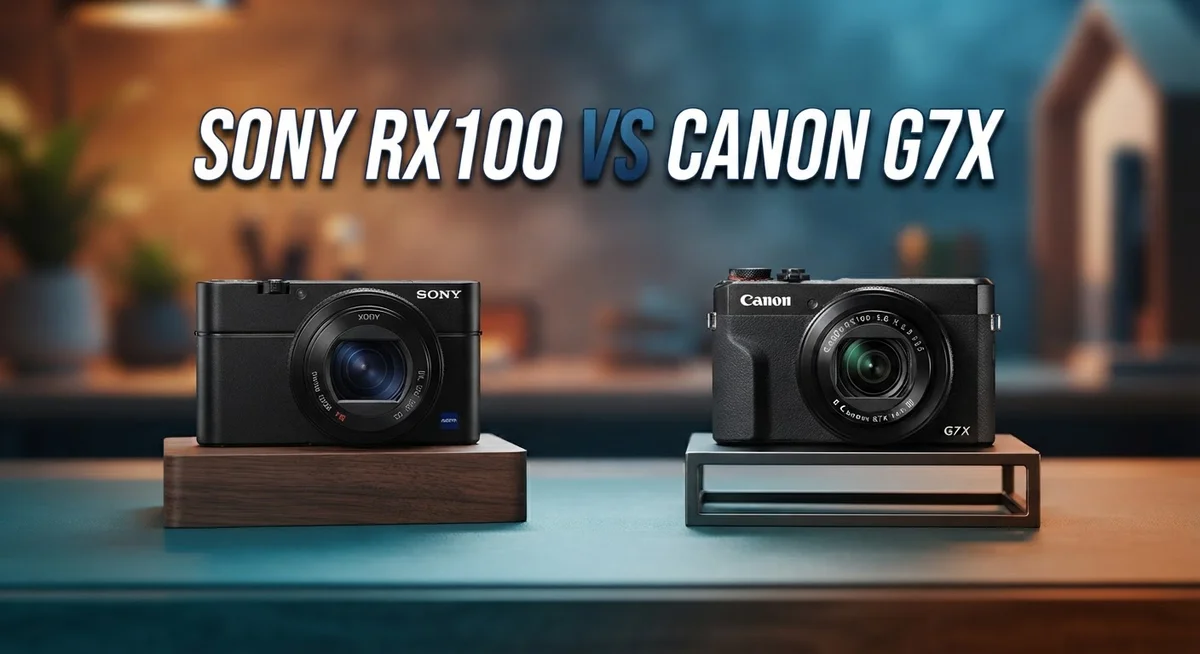
Picking a compact camera feels like a big decision. Two names always come up: the Sony RX100 and the Canon G7X. Both are small, powerful, and perfect for creators on the go.
But they are not the same camera. The Sony RX100 VII brings a long zoom and sharp 4K video. The Canon G7X Mark III brings a bright lens and lovely colors straight out of the camera.
So which one fits your needs? This guide breaks down the real differences between these two pocket giants. We will look at zoom range, video quality, autofocus speed, and everyday handling.
By the end, you will know exactly which camera matches your style. Let’s compare the Sony RX100 and Canon G7X side by side and find your perfect match.
In a Nutshell
Here’s the quick scoop on both cameras. Check these key points before you decide:
-
Zoom power: The Sony RX100 VII gives you a 24-200mm zoom range. This means you get closer to distant subjects without moving. The Canon G7X Mark III sticks to a fixed lens with less reach.
-
Video quality: Sony shoots 4K video at 30fps with sharp detail. Its autofocus tracks moving subjects fast and stays locked on.
-
Color output: Canon shines here. It produces beautiful colors straight out of the camera. You barely need to edit photos afterward.
-
Light handling: The G7X Mark III has a brighter lens. This helps in darker rooms or evening shots. It also includes a built in ND filter for bright outdoor scenes.
-
Shooting speed: Sony fires off 20 frames per second. This makes it great for action shots or fast moving kids and pets.
-
Overall vibe: Sony feels more responsive and modern. Canon has become a social media favorite, especially on TikTok.
Both cameras pack serious power into small bodies. Your choice depends on what you shoot most.
Zoom Range and Lens Capabilities
The zoom range is where these two cameras take very different paths. The Sony RX100 VII offers a 24-200mm zoom lens that gives you serious flexibility. You can shoot wide landscapes and then zoom in tight on distant subjects without changing lenses. This range means fewer compromises in the field.
The Canon G7X Mark III uses a fixed 24-100mm lens. It does not zoom as far, but this design choice comes with its own benefit. A fixed lens often means a brighter aperture, which lets in more light for better low light performance.
Sony’s zoom advantage matters most when you shoot varied subjects. Wildlife, events, and travel photography all benefit from that extra reach. You get 200mm of telephoto power in your pocket. The Canon maxes out at 100mm, so distant subjects require you to crop or move closer.
The aperture story is different though. Canon’s G7X Mark III has an f/1.8 to f/2.8 aperture range. Sony’s RX100 VII manages f/2.8 to f/4.5. That brighter Canon lens pulls in more light, especially at the wide end. This helps when shooting indoors or during sunset without a tripod.
Built-in ND filter is another Canon strength. The G7X Mark III includes a neutral density filter you can dial in instantly. This lets you use slower shutter speeds in bright sunlight for creative motion blur. Sony users need to buy a separate filter or use digital solutions.
For video work, Sony’s zoom range shines. You can frame shots without moving around as much. The extra reach helps when recording events or travel content. Canon’s fixed lens keeps things simple and bright, which some creators prefer for consistent lighting.
Think about what you shoot most. If you need flexibility and zoom range, Sony wins. If you value a brighter lens and built-in filters for video, Canon makes sense. Both lenses are sharp and well-built. The choice depends on your shooting style and the subjects you pursue most often.

- 20. 1MP 1. 0 Type stacked CMOS sensor, Zeiss Vario Sonnar T 24 200 millimeter F2. 8 F4. 5 large...
- 0. 02 sec. High AF speed, 357 point focal plane Phase detection AF and 425 point contrast detection...

Last update on 2026-10-12 / Affiliate links / Images from Amazon Product Advertising API
Video Performance and Frame Rates
Video performance separates these two cameras in meaningful ways. The Sony RX100 VII delivers 4K video at 30fps with excellent sharpness and detail. The Canon G7X Mark III maxes out at 1080p for standard video capture. This difference matters if you plan to edit or share footage online.
Frame rate options tell another story. Sony offers more flexibility with multiple recording speeds. You can shoot at 24fps, 30fps, or higher speeds depending on your model. Canon’s frame rate selection is more limited. For slow motion work, Sony pulls ahead significantly.
The Sony’s autofocus performance during video is noticeably faster and smoother. It tracks moving subjects without hunting or hesitation. Canon’s autofocus works well but feels slightly less responsive when recording. If you film people or action, Sony handles these situations better.
Stabilization differs between the two. Sony uses electronic stabilization that works across all frame rates. Canon combines optical and electronic stabilization. Both reduce shake effectively, but Sony’s system feels more consistent during pans and follows.
Low light video performance favors the Sony. Its newer sensor captures more detail when lighting drops. The Canon’s brighter lens helps in some situations, but the sensor advantage matters more for video. You’ll notice cleaner footage from Sony in dim environments.
Color science during video recording shows Canon’s strength. Footage straight from the camera looks polished and warm. Sony’s video colors need more adjustment in post production. If you want minimal editing, Canon’s colors feel more finished immediately.
The built-in ND filter on the Canon helps with video in bright sunlight. It lets you use slower shutter speeds for cinematic motion blur. Sony doesn’t include this feature. You’ll need an external filter if you want similar control.
Audio recording quality is comparable on both cameras. Both have microphone inputs for external mics. Sony’s audio performance is slightly cleaner with less background noise.
For serious video work, Sony wins on technical specs and responsiveness. Canon excels if you want pleasing colors right away. Your choice depends on whether you prioritize raw capability or ease of use.
Sensor Quality and Image Output
Sensor quality forms the foundation of image output. Both cameras deliver excellent results, but they approach image capture differently.
The Sony RX100 VII uses a newer sensor with superior light sensitivity. This means it captures cleaner images in dim conditions. The sensor size remains compact, yet it handles high ISO performance well. You get less noise when you push the camera in low light situations.
Canon’s G7X Mark III sensor excels at color accuracy straight from the camera. The out-of-the-box color science produces warm, pleasing tones without heavy editing. Many photographers appreciate this natural color rendering. The sensor performs admirably in daylight shooting scenarios.
Dynamic range tells an interesting story. Sony’s sensor captures more detail in shadows and highlights. This gives you greater flexibility during post-processing. You can recover blown-out skies or lift dark foreground areas more effectively. Canon’s sensor holds its own but offers slightly less headroom in extreme lighting situations.
Resolution sits at 20 megapixels on both cameras. This means file sizes stay manageable while maintaining excellent print quality. You won’t feel limited by megapixel count for typical uses.
Autofocus performance during still shooting differs noticeably. Sony’s autofocus is faster and more responsive, especially with moving subjects. The camera locks focus quickly and accurately. Canon’s autofocus performs well but feels slightly less snappy during rapid shooting sequences.
Noise performance becomes important in challenging light. Sony handles high ISO settings better overall. The image remains sharp and usable at higher sensitivities. Canon produces acceptable results but shows more visible grain at extreme ISO values.
Color reproduction depends on your preferences. If you want vibrant, accurate colors immediately, Canon delivers. If you prefer maximum editing flexibility and shadow detail, Sony wins. Neither camera produces poor colors. The choice reflects your workflow style.
Sensor stabilization works differently on each camera. Both offer in-body stabilization, though implementation varies. This affects sharpness in handheld shooting, especially at longer focal lengths or slower shutter speeds.
For professional image quality, both sensors perform admirably. Your choice depends on whether you prioritize straight-from-camera color or post-processing flexibility.
Top 3 Alternatives
Panasonic Lumix LX100

- Legendary LUMIX LX Series with manual controls Designed to Inspire Creativity
- Superior light capture with large, multi aspect micro four thirds sensor
Last update on 2026-11-08 / Affiliate links / Images from Amazon Product Advertising API
The Panasonic Lumix LX100 offers a fixed 24-75mm equivalent lens that gives you flexibility without changing lenses. This camera has a large sensor for its compact size, which means better image quality in low light conditions. The electronic viewfinder helps you see exactly what your photo will look like before you take it. You get manual controls that feel natural and intuitive. The build quality feels solid in your hands, and it’s lightweight enough to carry everywhere.
Ricoh GR III

- GR with a 40mm angle of view: A focal length of 40mm provides a highly versatile angle of view that...
- The ultimate snapshot camera-GR unchanging concept: High image quality, Quick response, Portability...
Last update on 2026-11-08 / Affiliate links / Images from Amazon Product Advertising API
The Ricoh GR III is ultra-compact and pocketable. It features a fixed 28mm lens that street photographers love. This camera focuses on simplicity. You get a high-resolution sensor packed into a tiny body. The autofocus speed is lightning-fast, so you never miss the moment. The image processing produces sharp, vibrant photos straight out of the camera. It’s perfect if you want something you can slip into your jacket pocket without thinking twice.
Fujifilm X100V

- Great photography every day, everywhere: X100V features a newly designed, incorporated 23 millimeter...
- Designed for quality and speed: From fleeting holiday moments and family celebrations to...
Last update on 2026-11-08 / Affiliate links / Images from Amazon Product Advertising API
The Fujifilm X100V combines retro design with modern technology. It has a fixed 35mm lens and a hybrid viewfinder that lets you switch between optical and electronic viewing. The sensor delivers stunning color reproduction that Fujifilm is famous for. The build feels premium, with dials and buttons that give you direct control over settings. Film simulation modes let you capture different looks in-camera. This camera appeals to photographers who want both performance and style in one package.
Autofocus Speed and Responsiveness
The autofocus systems in these cameras work very differently. Sony’s RX100 VII uses a hybrid autofocus system with phase detection and contrast detection combined. This dual approach makes it incredibly fast at locking onto subjects.
Canon’s G7X Mark III relies primarily on contrast detection autofocus. It works well in most situations, but it’s noticeably slower than Sony’s system. The difference becomes obvious when you’re tracking moving subjects or shooting in quick succession.
Speed matters most when you’re shooting fast moving action. The Sony locks focus in roughly 0.05 seconds. Canon takes longer, which can mean missed shots during unpredictable moments. For wildlife or sports photography, this gap is significant.
Responsiveness tells another story beyond raw speed. Sony’s autofocus adjusts smoothly as subjects move closer or farther away. You’ll notice this especially when recording video or panning across a scene. Canon’s system hunts more visibly, which some photographers find distracting.
Low light autofocus performance shows another clear winner. Sony’s phase detection system works better when light is dim. The Canon struggles more in shadowy conditions, sometimes hunting back and forth before locking. This matters if you shoot indoors or during golden hour.
Eye detection autofocus is where Sony shines brightest. The RX100 VII tracks eyes with impressive accuracy. Canon’s G7X Mark III has autofocus improvements, but eye tracking isn’t as reliable. For portrait work, Sony gives you more confidence that focus stays where you want it.
Continuous autofocus during video differs between the two. Sony maintains smooth focus as subjects move. Canon can be jerky during video autofocus adjustments. The Sony feels more natural and professional when you’re filming.
Manual focus override works on both cameras, but Sony offers faster access to manual controls. You can switch between autofocus and manual more quickly on the Sony.
For most photographers, Sony’s autofocus speed and responsiveness represent a genuine advantage. You’ll spend less time waiting for focus and more time capturing moments. Canon’s system works fine for deliberate shooting, but it won’t match Sony’s speed when things move fast.
Built-In Features and Convenience
The built-in features on these cameras make a real difference in daily shooting. The Canon G7X Mark III includes a built-in ND filter, which lets you shoot in bright sunlight without worrying about overexposure. This feature saves time because you don’t need to carry extra filters or swap accessories in the field.
The Sony RX100 VII offers more shooting modes and menu customization. You get access to more creative options right out of the box. The Sony also includes interval shooting, which lets you create time-lapses without external gear.
Both cameras have flip screens, but they work differently. The Canon’s screen tilts up and down. The Sony’s screen tilts and also flips all the way around, giving you more flexibility for selfies or low-angle shots.
Connectivity features show another distinction. The Sony connects faster to smartphones through its app. You can transfer images quickly and control the camera remotely. The Canon also offers Bluetooth and WiFi, but the connection feels less seamless in real-world use.
Battery life matters when you’re out shooting all day. The Canon typically lasts longer on a single charge. The Sony drains faster, especially when using the flip screen or shooting 4K video. You’ll want a spare battery for the Sony if you plan extended shooting sessions.
Menu systems differ significantly. The Sony’s menus feel more logical and easier to navigate. The Canon requires more button presses to access certain settings. For new users, the Sony feels more intuitive.
The Sony includes 4K video recording as standard. The Canon shoots Full HD video mainly, though newer versions offer 4K. This matters if video is part of your creative work.
Both cameras include manual mode controls and RAW shooting. You get full creative control on either camera. The Sony simply offers more convenience features overall. The Canon excels with its ND filter and longer battery life.
Pros and Cons
Pros
- Sony RX100 VII delivers a massive 24-200mm zoom range that Canon simply cannot match
- Canon G7X Mark III produces warmer, more natural colors straight out of the camera without heavy editing
- Sony’s 4K video at 30fps gives you professional-grade footage that Canon’s setup cannot replicate
- Canon includes a built-in ND filter, eliminating the need to carry extra accessories
- Sony’s eye detection autofocus locks onto faces faster and more reliably during both photos and video
Cons
- Sony RX100 VII has a smaller maximum aperture, meaning less light reaches the sensor in dim conditions
- Canon G7X Mark III uses a fixed lens, so you cannot zoom as far or get as creative with framing
- Canon’s autofocus struggles with fast-moving subjects compared to Sony’s hybrid system
- Sony’s smaller sensor in earlier RX100 models means more noise appears in low light situations
Who Should Buy It
The Sony RX100 VII suits photographers who need maximum flexibility and zoom range. If you shoot everything from wide landscapes to distant subjects, Sony’s 24-200mm lens covers nearly all situations without lens changes. This camera works best for travel photographers and content creators who want one device for varied shots.
Choose the Sony if you prioritize video performance. The 4K recording at 30fps produces professional-quality footage. Eye detection autofocus locks onto faces instantly during both photos and video. Fast-moving action and wildlife benefit greatly from Sony’s responsive autofocus system. Video enthusiasts and vloggers find this camera particularly capable.
The Canon G7X Mark III appeals to photographers who want simplicity and natural colors. The fixed lens means you focus on composition rather than adjusting zoom constantly. Out-of-the-camera colors appear warm and natural, reducing editing time. This camera suits street photographers and those who prefer a straightforward shooting experience.
Pick the Canon if you shoot frequently in bright daylight and value convenience features. The built-in ND filter eliminates carrying extra accessories. The brighter aperture handles outdoor shooting smoothly. Photographers who dislike fiddling with filters and settings appreciate this approach.
The Sony RX100 VII works better for professional or semi-professional use. Content creators, travel vloggers, and photographers earning income from their work benefit from superior zoom and video capabilities. The extensive shooting modes and menu customization support creative control.
The Canon G7X Mark III suits casual photographers and enthusiasts. Weekend explorers, family trip documentarians, and hobbyists enjoy the straightforward operation. The fixed lens encourages you to move around and compose thoughtfully rather than relying on zoom.
Sony appeals to those wanting one camera for multiple purposes. Photography, video, zoom range, and autofocus performance all receive priority. Canon appeals to those wanting one camera that just works. Simplicity, pleasant colors, and reliable performance take priority.
Your choice depends on your shooting style. Versatility and performance features matter more to you? Choose Sony. Simplicity and natural results matter more? Choose Canon.
Final Verdict
Both cameras deliver great results, but they serve different photographers. Your final decision should match your daily shooting habits and creative goals.
The Sony RX100 VII stands out as the more complete tool. It handles more situations, from wildlife shots to fast action clips. This makes it a smart pick if you want one camera that grows with your skills.
The Canon G7X Mark III shines for social content creators. Its natural color output and simple controls make quick posts easy. Many vloggers on TikTok and Instagram love this camera for that exact reason.
Think about how you actually use a camera. If you shoot spontaneous moments and want zero editing fuss, Canon fits your style. If you plan trips, events, or want strong video output, Sony makes more sense.
Neither camera is a wrong choice. Both brands have refined these models over several years. You get reliable RAW shooting, solid manual controls, and dependable build quality either way.
Consider your future needs too. If you think you might want more zoom reach later, the Sony saves you from buying a new camera sooner. If you prefer sticking to one simple setup, Canon keeps things easy.
Test drive both if you can. Handle each camera in a store or borrow one from a friend. The physical feel and menu logic differ enough to matter for daily use.
In the end, your shooting style should guide this decision. Sony rewards versatility and video power. Canon rewards simplicity and color accuracy.
Pick the camera that matches how you actually shoot, not just the specs sheet. Both remain strong choices among today’s compact camera lineup, and either one will serve you well for years of everyday photography.
Frequently Asked Questions
Which camera has better autofocus performance?
The Sony RX100 VII wins here. Its eye detection autofocus locks onto faces faster and more reliably during both photos and video. You’ll notice the difference when shooting moving subjects or fast-paced scenes. The Canon G7X Mark III has solid autofocus, but Sony’s system responds quicker in real-world shooting.
Can I use both cameras in low light situations?
The Canon G7X Mark III performs better in dim conditions. Its brighter lens allows more light to reach the sensor. The Sony RX100 VII has a smaller maximum aperture, which means less light enters in low light scenarios. However, Sony compensates with faster autofocus and better sensor technology. For indoor events or evening shots, the Canon gives you an easier time without pushing ISO too high.
What if I want to shoot video content?
Choose Sony. The RX100 VII shoots 4K video at 30fps, giving you professional-grade footage that the Canon cannot match. Sony’s video autofocus is also more responsive during recording. If you create content for social media or need smooth video clips, Sony handles the job better. The Canon works fine for casual video, but Sony is the clear choice for serious video work.
Does the built-in ND filter on the Canon matter?
Yes, it saves you money and hassle. The Canon G7X Mark III includes a built-in ND filter, so you don’t carry extra accessories. This filter lets you use slower shutter speeds in bright daylight. The Sony lacks this feature, meaning you need to buy a separate filter if you want the same capability. For convenience and simplicity, the Canon wins this round.
Which camera offers more creative flexibility?
Sony RX100 VII gives you more options. Its 24-200mm zoom range lets you frame shots differently and reach distant subjects. You can zoom in for wildlife or zoom out for landscapes. The Canon G7X Mark III uses a fixed lens, so your framing choices are limited. If you want maximum creative control, the Sony delivers it.

Dillip is the founder and editor of ImageScaleLab.com, a passionate tech enthusiast who loves breaking down complex gadgets and accessories into simple, honest reviews and buying guides. With years of hands-on experience exploring the latest in tech, he is dedicated to helping readers make smarter, more confident purchasing decisions.