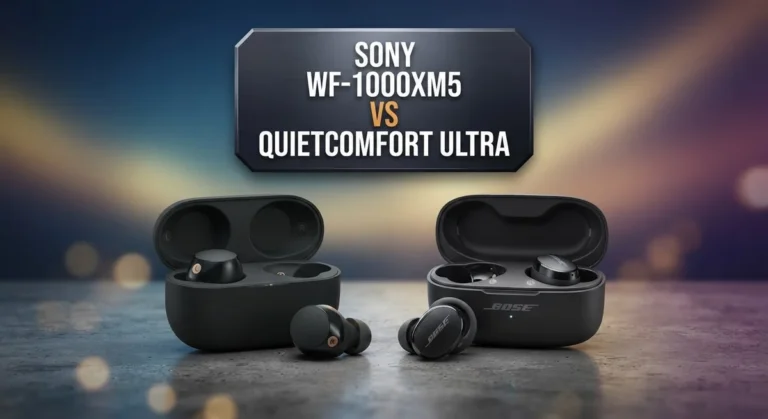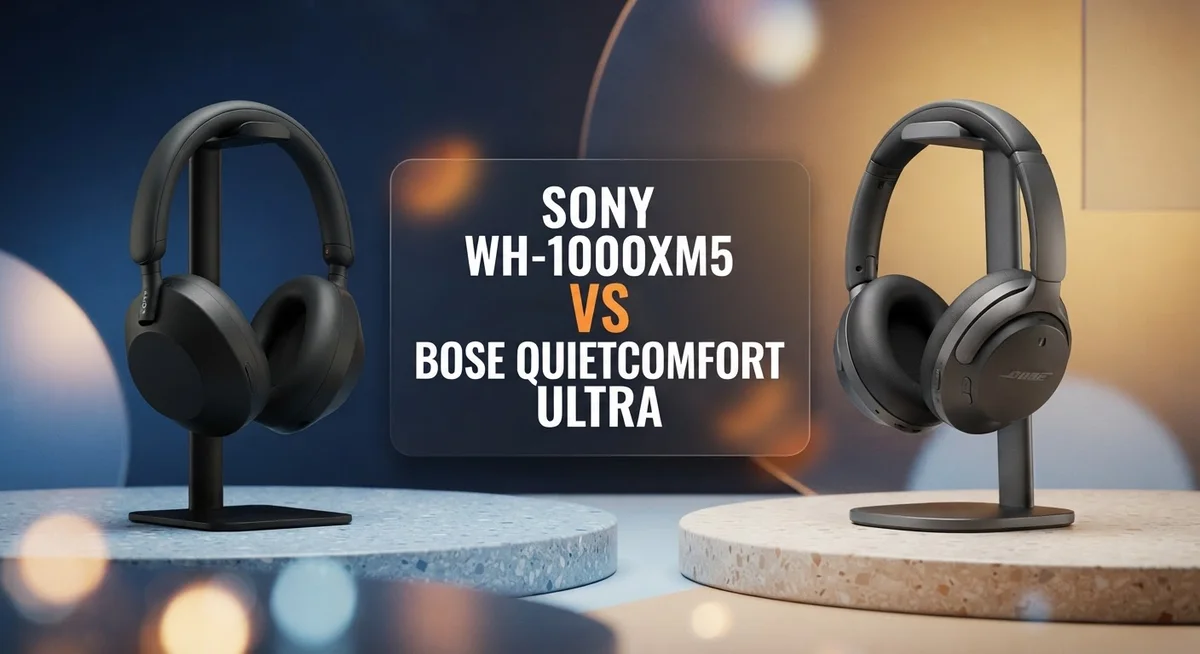
Sony WH-1000XM5 vs Bose QuietComfort Ultra: Premium Noise-Canceling Headphones Compared
Picking your next pair of headphones feels like a big decision. Two names always come up: Sony WH-1000XM5 and Bose QuietComfort Ultra.
Both brands promise comfort, clear sound, and smart noise cancellation. But they take different paths to get there.
The Sony WH-1000XM5 focuses on light comfort and smart features like Speak-to-Chat. It also lets you fine tune sound with a custom EQ app.
The Bose QuietComfort Ultra brings stronger noise cancellation and a richer, fuller sound. It folds up neatly, making it easier to carry around.
So which one fits your daily life better? We break down comfort, sound quality, and noise cancellation. By the end, you will know exactly which headphones deserve a spot in your bag.
In a Nutshell
Here is the quick summary for you.
-
Sony WH-1000XM5 feels lighter on your head. It has minimal headband pressure. This makes it great for long listening sessions.
-
Bose QuietComfort Ultra blocks more outside noise. Its ANC performance stands out in loud places like airports or busy streets.
-
Sony offers a custom EQ app. You can adjust sound settings to match your taste easily.
-
Bose delivers a richer, fuller sound with more body. Sony leans toward smart features like Speak to Chat and adaptive ambient mode.
-
Bose folds flat and fits in a compact case. This makes it easier to pack for travel.
-
Sony has less audio leakage than Bose. So people around you will hear less of your music.
-
Bose has a stronger clamping force. Some users may find it a bit less comfortable over time.
-
Both headphones use Bluetooth 5.2. Sony adds LDAC support for higher quality audio streaming.
Your choice depends on what matters most to you. Pick Sony for comfort and smart features. Pick Bose for noise blocking and portability.
Noise Cancellation and Sound Quality
When you listen to music through these headphones, sound quality matters just as much as silence. The Sony WH-1000XM5 uses LDAC codec support, which means it handles high-resolution audio better than standard Bluetooth connections. This gives you richer detail when you stream lossless files from compatible apps.
The Bose QuietComfort Ultra takes a different approach. It focuses on delivering a fuller, warmer sound across all music genres. You get more bass body and presence in the midrange, which many listeners find satisfying for everyday listening.
Noise cancellation performance separates these two headphones clearly. Bose’s ANC system works harder to eliminate background noise in real world situations. You’ll notice the difference in loud offices, coffee shops, and on airplanes. The Bose algorithm adapts faster when noise levels change suddenly.
Sony’s noise cancellation feels more refined and natural. It doesn’t create that “sealed cabin” pressure some people find uncomfortable. Sony also excels at noise gating, which means it reduces audio leakage when you’re in noisy environments. If you sit next to someone else, they hear less of your music bleeding through.
One key difference appears in quiet environments. The Bose headphones sound clearer and more defined when there’s minimal background noise. Sony’s sound feels slightly more neutral, which appeals to people who want accurate audio without coloration.
The Sony app lets you adjust EQ settings to match your taste. You can boost bass, reduce treble, or create custom presets. The Bose app offers fewer customization options, so you get what Bose’s engineers chose for you.
Both headphones use Bluetooth 5.2, but Sony’s LDAC advantage matters only if your phone and music app support it. For standard Bluetooth audio, the difference becomes much smaller.
Your choice depends on priorities. Pick Sony if you want natural noise cancellation and sound customization. Pick Bose if you prefer aggressive noise blocking and a warmer, fuller sound signature right out of the box.

- Revolutionary noise cancellation: The Sony WH-1000XM5 wireless headphones set a new standard with...
- Immersive sound, uncompromised clarity: Experience exceptional audio fidelity with newly developed...
Last update on 2026-11-07 / Affiliate links / Images from Amazon Product Advertising API
Design, Comfort, and Portability
When you hold the Sony WH-1000XM5, you notice minimal headband pressure. Your ears feel free from clamping. The design sits light on your head during long listening sessions.
The Bose QuietComfort Ultra applies a stronger clamping force. Some users feel this pressure after wearing them for several hours. Your head shape matters here. A tighter fit might feel secure to you or uncomfortable depending on your preference.
Sony’s headphones weigh slightly less overall. This matters when you wear them all day at work or during travel. The lighter feel reduces neck strain over time.
Bose wins on portability with its foldable design. The headphones fold flat and slip into a compact carrying case. You can toss them in a backpack without taking up much space. Sony’s headphones don’t fold, so they need more room in your bag.
The Sony design feels more solid when you hold it. Materials feel premium and durable. Bose’s construction feels slightly more delicate. Some users report concerns about long term durability with frequent folding and unfolding.
Audio leakage differs between these two models. Sony has less sound escaping into your surroundings. This matters in quiet offices or libraries. Bose leaks more audio, so people nearby might hear your music. If you share close spaces with others, Sony handles this better.
Both headphones use Bluetooth 5.2 for wireless connection. Pairing happens quickly with your phone or tablet. The connection stays stable during your commute or workout.
Your choice here depends on your daily life. Choose Sony if you value all day comfort and less audio leakage. Pick Bose if you travel often and need something that fits easily in your bag. Consider how long you wear headphones each day. Think about where you use them most. Your personal comfort matters more than any single feature. Test both models if possible before deciding. Your ears will thank you for taking time to choose the right fit.
Connectivity and Audio Codecs
Both headphones connect via Bluetooth 5.2, which means they offer solid wireless range and stability. However, the real difference lies in their audio codec support.
The Sony WH-1000XM5 supports LDAC, a high-quality codec that streams music at higher bitrates than standard Bluetooth. This matters if your phone and music app support LDAC. You get clearer, more detailed audio when everything lines up. The Sony also handles SBC and AAC codecs for broader device compatibility.
The Bose QuietComfort Ultra sticks with SBC and AAC codecs. These are industry standard and work with virtually every device. You won’t get the extra detail that LDAC provides, but you get reliable, consistent performance across all your gadgets.
Here’s what this means in real life. If you stream from a Sony phone with a music app that supports LDAC, the Sony headphones shine. If you switch between multiple devices or use standard streaming apps, both headphones perform similarly. The codec difference becomes noticeable mainly to audiophiles who pay close attention to sound detail.
Connection stability feels nearly identical on both models. They both maintain strong links to your phone during everyday use. Neither one drops the signal unexpectedly when you move around your home or office.
The Sony’s custom EQ app lets you fine tune your audio experience through software. This gives you another layer of control beyond just the codec advantage. The Bose approach keeps things simpler with fewer customization options.
One practical note: LDAC streams larger data files, which uses slightly more battery power. If battery life concerns you, this minor difference might matter over an entire day of listening.
Your choice here depends on your tech setup. Choose Sony if you use compatible devices and want maximum audio detail. Pick Bose if you value simplicity and device flexibility. Both deliver excellent connectivity for everyday use, and the codec difference only becomes obvious to experienced listeners who know what to listen for.
Top 3 Alternatives
Sennheiser Momentum 4

- Seamless Firmware & App Updates: Enjoy a smoother, more reliable experience with the latest firmware...
- Audiophile-Inspired Sound : Sennheiser wireless headphones over ear with Signature Sound, 42mm...
Last update on 2026-11-07 / Affiliate links / Images from Amazon Product Advertising API
The Sennheiser Momentum 4 delivers exceptional battery life that outlasts most competitors. You get up to 60 hours of listening on a single charge. The sound quality emphasizes clarity and detail across music genres.
These headphones feature active noise cancellation that performs well in busy environments. The build feels premium with leather ear cups and a sturdy headband. Comfort matters here—the padding supports long listening sessions without fatigue.
Apple AirPods Max

- ULTIMATE OVER-EAR LISTENING EXPERIENCE—Powered by the H2 chip, AirPods Max 2 delivers improved...
- TUNE OUT THE NOISE—Up to 1.5x more Active Noise Cancellation than the previous generation, fully...

Last update on 2026-11-07 / Affiliate links / Images from Amazon Product Advertising API
Apple’s AirPods Max bring spatial audio directly into your listening experience. The technology creates an immersive soundscape that works best with Apple devices. Setup happens instantly when you own an iPhone or Mac.
The design stands out with its distinctive stainless steel frame and mesh band. Sound quality leans toward crisp highs and balanced mids. Active noise cancellation adapts to your environment automatically. Battery life reaches about 20 hours, which covers most users’ daily needs.
Jabra Elite 45h

- EXCEPTIONAL SOUND – With the advanced 40 millimeter speakers – the biggest this headphone...
- UP TO 50 HOURS OF USE – Get up to 50 hours of battery life from a single charge, giving you more...
Last update on 2026-11-07 / Affiliate links / Images from Amazon Product Advertising API
The Jabra Elite 45h offers solid noise cancellation without the premium price tag. Battery performance reaches 50 hours, making these ideal for frequent travelers. The sound signature stays neutral, letting vocals and instruments shine equally.
Comfort comes from the lightweight design and soft ear cushions. These headphones work seamlessly across Android and iOS platforms. Call quality improves thanks to multiple microphones that filter background noise. The build quality feels durable, and the controls respond quickly to your touch.
Each option serves different needs. Choose Sennheiser for maximum battery life, Apple for ecosystem integration, or Jabra for balanced performance and value.
Ambient Mode and Voice Features
The Sony WH-1000XM5 includes Speak-to-Chat technology. This feature pauses your music automatically when you start talking. You don’t need to remove the headphones or press buttons. The system detects your voice and handles the transition smoothly.
The Bose QuietComfort Ultra takes a simpler approach to voice features. It focuses more on call quality than ambient voice detection. Both headphones pick up your voice clearly during calls, but Sony adds that extra convenience layer.
Ambient mode works differently on each model. Sony’s adaptive ambient mode adjusts how much outside sound enters based on what you’re doing. If you’re walking, it lets in more noise. If you’re stationary, it reduces ambient sound. This keeps you aware without overwhelming you.
Bose’s ambient mode feels more straightforward. You toggle it on or off, and it maintains a consistent level of outside sound. This approach works well if you prefer predictable ambient listening. You know exactly what to expect each time you activate it.
The Sony’s noise gating performs better in loud environments. When you’re in a coffee shop or on a busy street, Sony filters out background noise more effectively while keeping voices clear. Bose handles ambient modes well, but Sony’s gating gives you clearer communication in chaotic settings.
Voice call quality matters for daily use. Both headphones deliver solid microphone performance. Sony edges ahead slightly with its advanced noise gating that removes background chatter during calls. Bose maintains clearer sound in quiet environments, which helps during office calls or home conversations.
The real difference comes down to your lifestyle. If you move between quiet and loud spaces frequently, Sony’s adaptive ambient mode adapts to your situation automatically. If you prefer manual control and consistency, Bose’s straightforward toggle works better.
Both headphones let you hear your own voice during calls. This prevents you from shouting accidentally. The experience feels natural on both models, though Sony’s Speak-to-Chat adds an extra layer of convenience that Bose doesn’t match.
Customization and App Experience
When you open the Sony WH-1000XM5 app, you get access to a full custom EQ interface. You can adjust bass, midrange, and treble to match your taste. The app also includes presets for different music genres.
The Bose app takes a different approach. It focuses on simplicity rather than deep customization. You get quick access to ANC settings and ambient mode controls without overwhelming menus.
Sony’s app experience gives you more control over sound signature. You can save multiple EQ profiles for different listening scenarios. This matters if you switch between podcasts, music, and movies throughout your day.
Bose’s interface prioritizes ease of use. New users find it less intimidating. The app loads quickly and responds smoothly to your adjustments. You won’t spend time hunting through settings to change basic features.
The Sony app includes additional features beyond EQ. You can manage Speak-to-Chat settings and customize how ambient mode responds to your environment. The app also tracks battery life with precision.
Bose keeps things streamlined. The app shows your battery percentage and lets you toggle between ANC modes effortlessly. Some users appreciate this straightforward design. Others want more granular control.
Real world usage reveals important differences. Sony users spend more time in the app initially, learning features and creating custom presets. Once set up, they rarely need to return. Bose users access the app frequently but for quick adjustments only.
Both apps connect reliably via Bluetooth. Neither app drains your phone battery significantly. Connection stability between your phone and headphones remains strong with both options.
Sony’s custom EQ approach works best if you care about sound tuning. You might adjust settings weekly based on your mood or content type. Bose’s simpler approach suits people who want to play music without tweaking anything.
The app experience ultimately reflects each brand’s philosophy. Sony emphasizes user control and customization depth. Bose emphasizes simplicity and intuitive navigation. Your preference depends on whether you enjoy exploring audio settings or prefer a set-and-forget approach.
Pros and Cons
Pros
- Sony WH-1000XM5: Minimal headband pressure makes them comfortable for all day wear without fatigue
- Sony WH-1000XM5: Excellent noise gating keeps conversations clear even in busy, loud spaces
- Bose QuietComfort Ultra: Superior ANC performance blocks out more ambient noise than Sony
- Bose QuietComfort Ultra: Richer sound with more body and presence in the midrange frequencies
- Bose QuietComfort Ultra: Foldable design fits easily into bags and travel cases for portability
Cons
- Sony WH-1000XM5: More audio leakage means sound escapes to people sitting nearby
- Sony WH-1000XM5: Less portable due to bulkier design and larger carrying case
- Bose QuietComfort Ultra: Stronger clamping force can feel tight during extended listening sessions
- Bose QuietComfort Ultra: Feels more fragile overall, requiring careful handling during daily use
Who Should Buy It
The Sony WH-1000XM5 works best for people who spend long hours wearing headphones. You’ll appreciate the minimal headband pressure that keeps your ears comfortable all day. If you tweak audio settings often, Sony’s custom EQ app gives you complete control over your sound signature.
Choose Sony if you work in loud offices or crowded spaces. The excellent noise gating keeps your voice clear during calls even when traffic or machinery runs nearby. This feature matters a lot for remote workers and frequent travelers.
The Bose QuietComfort Ultra suits people who want the strongest noise cancellation available. You get superior ANC performance that blocks out more ambient noise than Sony. This makes Bose ideal for flights, trains, and open office environments where you need maximum isolation.
Pick Bose if you travel frequently and value portability. The foldable design fits easily into backpacks and airplane seat pockets. The compact case takes up minimal space compared to Sony’s larger carrying case. Frequent flyers and commuters appreciate this convenience.
Bose works well if you prefer straightforward controls without much customization. The app keeps things simple and intuitive. You won’t spend time adjusting EQ curves or exploring advanced settings. Just connect and enjoy your music.
Choose Sony if you listen to music in quiet environments where sound detail matters. The LDAC codec delivers higher quality audio files when you use compatible devices. Audiophiles and music lovers notice the difference immediately.
The Bose QuietComfort Ultra sounds richer with more body in the midrange. If you enjoy vocals and instruments with presence and warmth, Bose delivers this naturally. You don’t need to adjust settings to get this fuller sound.
Pick Sony if you want advanced features like Speak-to-Chat technology. This lets you pause music automatically when you start talking. It’s a small feature that makes daily life smoother.
Ultimately, choose Sony for customization and all-day comfort. Choose Bose for superior noise cancellation and travel convenience. Both headphones excel in different situations. Your lifestyle determines which one fits better into your routine.
Final Verdict
Both headphones deliver strong performance, but they serve different needs. Your final choice depends on what matters most to you: comfort, sound signature, or build quality.
The Sony WH-1000XM5 stands out for people who prioritize long term wearability. If you spend hours each day with headphones on, this pair reduces fatigue better than its rival.
The Bose QuietComfort Ultra takes the lead in raw noise blocking power. It also delivers a fuller, more textured sound that many listeners prefer for music heavy days.
Build quality tells its own story too. Bose feels lighter but less sturdy, while Sony holds up better against daily wear and tear.
Think about your lifestyle before deciding. Frequent travelers benefit from Bose’s compact folding design. Office workers or remote employees often lean toward Sony for its steady comfort.
Sound preference plays a role as well. If you enjoy a warmer, bass forward profile, Bose satisfies that craving. If you want cleaner mids and highs, Sony delivers a more balanced tone.
Neither pair is flawless. Both leak some sound at higher volumes, so open office use might annoy people nearby. Weigh this against your daily environment.
Durability and daily habits matter just as much as specs. If you often toss your headphones in a bag without a case, Sony’s sturdier frame offers peace of mind. If gentle handling is your norm, Bose’s slim design becomes a real advantage.
In short, there is no universal winner here. Sony wins for comfort seekers and steady desk users. Bose wins for travelers and bass lovers who want top tier noise cancellation.
Your final decision should reflect how you actually use headphones each day. Pick the pair that matches your routine, not just your wish list.
Frequently Asked Questions
Which headphones have better battery life?
Both the Sony WH-1000XM5 and Bose QuietComfort Ultra deliver solid battery performance for all-day listening. Sony offers around 8 hours of continuous playback with ANC enabled. Bose provides similar endurance in real-world use. Your actual battery life depends on volume levels, ANC settings, and codec usage. Both charge quickly with their included cables.
Can I use these headphones for phone calls?
Yes, both models work well for calls. The Sony WH-1000XM5 excels here with its Speak-to-Chat feature. This technology automatically pauses music when you start talking. You don’t need to remove the headphones to have a conversation.
The Bose QuietComfort Ultra handles calls smoothly too. It uses straightforward microphone arrays without special automation. Both provide clear voice pickup in most environments.
Do these headphones work with all devices?
Both use Bluetooth 5.2, so they connect to smartphones, tablets, laptops, and other standard devices. The Sony supports LDAC codec for higher quality wireless audio on compatible players. Bose sticks with standard codecs like AAC and SBC.
Sony’s app gives you custom EQ controls and feature tweaks on Android and iOS. Bose keeps things simpler with fewer app customizations available.
Which one feels better during long listening sessions?
The Sony WH-1000XM5 applies minimal headband pressure. Your ears stay comfortable for 8+ hours without fatigue. Many people forget they’re wearing them.
The Bose QuietComfort Ultra clamps tighter around your head. Some users feel pressure after several hours. This design choice helps with stability but sacrifices comfort for extended wear.

Dillip is the founder and editor of ImageScaleLab.com, a passionate tech enthusiast who loves breaking down complex gadgets and accessories into simple, honest reviews and buying guides. With years of hands-on experience exploring the latest in tech, he is dedicated to helping readers make smarter, more confident purchasing decisions.