
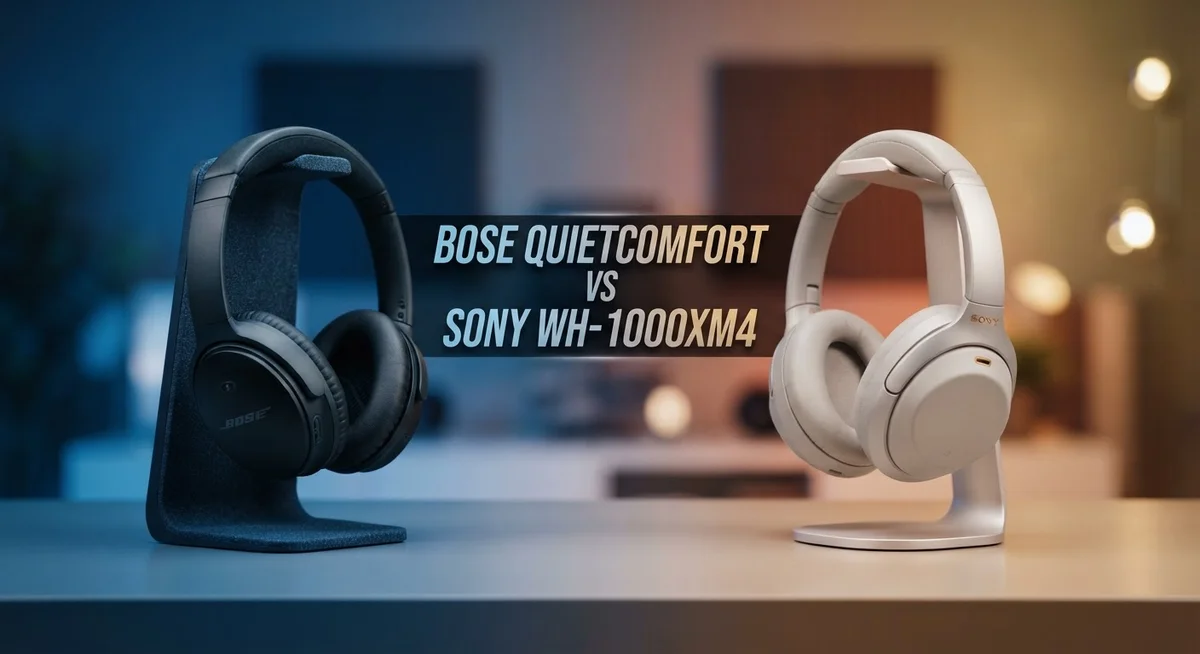
Bose QuietComfort vs Sony WH-1000XM4: Complete Headphones Comparison
Picking the right headphones can feel tricky. Two names always come up: Bose QuietComfort and Sony WH-1000XM4. Both promise silence, comfort, and great sound.
But which one fits your life better? That’s what we’re here to find out.
The Sony WH-1000XM4 brings adaptive noise cancellation and a 30-hour battery life. It delivers crisp highs and powerful lows. Many users love its rich, detailed sound.
Bose, on the other hand, has built a reputation for supreme comfort and simple controls. It’s a favorite for long flights and busy workdays.
Both brands have loyal fans. Both claim the noise cancelling crown. So we’re comparing them side by side.
We’ll look at comfort, sound quality, and daily usability. By the end, you’ll know exactly which pair deserves a spot on your ears.
In a Nutshell
Here’s a quick summary to help you decide fast.
-
Sony WH-1000XM4 shines with adaptive noise cancellation. It adjusts to your surroundings automatically. This makes it great for busy places like airports or offices.
-
Sound quality on the Sony is crisp and rich. You get powerful lows and clear highs. Mids sound full and balanced too.
-
Bose QuietComfort wins on comfort. The fit feels light even after long wear. Controls stay simple and easy to use.
-
Sony’s build quality feels solid, but the design runs bulky. Some users find it less sleek than Bose options.
-
Call quality is a weak spot for Sony. The microphone often sounds muffled to people on the other end.
-
Sony’s interface can feel unresponsive at times. Bose keeps things straightforward with fewer menus to fuss over.
-
Newer models like the XM5 and XM6 beat the XM4 in noise cancellation. Keep that in mind if future proofing matters to you.
Both headphones serve different needs. Choose based on what matters most: comfort or sound tuning.
Noise Cancellation Technology
The Sony WH-1000XM4 uses adaptive noise cancellation technology. This system learns your environment and adjusts sound blocking in real time. The headphones detect ambient noise patterns and respond automatically.
Bose QuietComfort takes a different approach. Bose focuses on consistent, steady noise reduction rather than constant adaptation. The technology prioritizes comfort during long listening sessions.
Sony’s adaptive system excels in changing environments. You move from a quiet office to a busy street. The headphones shift their ANC strength without manual adjustment. This intelligent response keeps you immersed in your content.
Bose’s method offers simplicity and reliability. The noise cancellation stays stable throughout your day. You don’t experience sudden shifts in sound pressure. Many users prefer this straightforward performance.
The Sony WH-1000XM4 includes multiple microphones for ANC processing. These work alongside your call microphones. The result is sophisticated noise detection across different frequencies. However, newer Sony models like the XM5 and XM6 deliver superior ANC performance overall.
Bose QuietComfort headphones use fewer processing layers. This streamlined approach reduces battery drain. Your listening experience remains consistent whether you’re in an airplane or a coffee shop.
Real world testing shows both handle common noises well. Office chatter, traffic sounds, and background hum all diminish significantly. The Sony captures more high frequency noise. Bose blocks low frequency rumble more effectively.
Your choice depends on your daily environment. Do you face constantly changing soundscapes? The Sony’s adaptive technology serves you better. Do you prefer predictable, steady performance? Bose delivers that experience reliably.
The Sony WH-1000XM4 represents mature ANC technology. It performs admirably for most situations. Bose QuietComfort represents a different philosophy. Both approaches work. Neither is objectively superior. Your lifestyle determines which suits you best.

- ACTIVE NOISE CANCELLATION: Premium noise canceling with Dual Noise Sensor technology
- LONG BATTERY LIFE: Up to 30-hour battery life with quick charging (10 min charge for 5 hours of...
Last update on 2026-11-08 / Affiliate links / Images from Amazon Product Advertising API
Sound Quality and Audio Performance
When it comes to audio output, these two headphones take different approaches to what “great sound” means.
The Sony WH-1000XM4 delivers a signature sound profile that emphasizes clarity and punch. You get crisp highs that make vocals pop, powerful lows that add impact to music, and rich mids that keep everything balanced. The adaptive noise cancellation actually enhances this experience because it removes background distractions. Your ears focus purely on what the headphones play.
Bose QuietComfort headphones favor a warmer, more natural sound signature. The audio feels less aggressive and more suited to long listening sessions. Bose listeners often describe the sound as smooth and forgiving, which means less fatiguing over time.
Bass response differs between the two. Sony pushes deeper bass frequencies with more emphasis, making electronic music and hip-hop feel dynamic. Bose keeps bass present but controlled, which some prefer for classical music and podcasts.
The Sony’s app includes an EQ function. You can adjust the sound to match your taste. Bose offers simpler controls without extensive customization options built into most QuietComfort models.
Frequency response matters here too. Sony covers a wider range, which technically means more detail retrieval across the audio spectrum. Bose stays more conservative, focusing on the frequencies most people actually listen to.
Real-world testing shows Sony handles sudden volume changes better. When you switch from quiet passages to loud sections, the Sony adapts smoothly. Bose maintains steadier levels but may feel less dynamic in comparison.
Comfort affects sound perception. If headphones feel heavy or cause ear fatigue, your brain interprets the sound differently. This gives Bose an indirect advantage since its lighter design means you’ll enjoy the audio longer without discomfort.
Both headphones work well for different content. Choose Sony if you want analytical detail and bass impact. Pick Bose if you prefer relaxed listening and natural reproduction. Your music preference ultimately determines which sounds “better” to your ears.
Design, Comfort, and Portability
The physical design of these headphones tells two different stories. Sony built the WH-1000XM4 with a focus on features packed into a compact frame. Bose QuietComfort prioritizes simplicity and lightweight construction. Sony’s design feels more angular and modern, while Bose opts for smooth, rounded edges that appeal to minimalist users.
Weight matters when you wear headphones all day. The Bose model sits lighter on your head and neck. Sony’s headphones carry more heft, which some people notice after extended listening sessions. Both include carrying cases, though Sony’s hard case takes up more space in a bag.
Comfort extends beyond weight. Bose QuietComfort headphones feature softer ear cushions that feel gentler during long wear. The headband padding on Bose models distributes pressure more evenly across your scalp. Sony’s ear cups feel firmer and may require a short break-in period before they feel natural.
Adjustability differs between the two. Sony includes more adjustment options through its app, letting you customize how the headphones sit and feel. Bose keeps physical adjustments simple with a basic headband slider. This simplicity means fewer things can break or go wrong.
Portability favors different users. If you travel frequently and want something compact, Sony’s case fits neatly into backpacks. Bose’s lighter weight makes it easier to carry without a case if you prefer minimal luggage. The Sony folds more compactly, while Bose doesn’t fold quite as small.
Heat buildup happens with both models during summer use. Sony’s ear cups trap slightly more warmth due to their design. Bose’s ventilation feels marginally better for hot climates. Neither model excels in this area, so expect some discomfort during intense heat.
The choice comes down to your priorities. Choose Bose if comfort during marathon listening sessions matters most. Choose Sony if you need a headphone that fits easily into tight spaces. Both handle daily use well, just in different ways. Your lifestyle and environment should guide this decision.
Top 3 Alternatives
Sennheiser Momentum 4

- Seamless Firmware & App Updates: Enjoy a smoother, more reliable experience with the latest firmware...
- Audiophile-Inspired Sound : Sennheiser wireless headphones over ear with Signature Sound, 42mm...
Last update on 2026-11-08 / Affiliate links / Images from Amazon Product Advertising API
The Sennheiser Momentum 4 offers exceptional battery life that outlasts most competitors. You get up to 60 hours of listening time on a single charge. The sound quality delivers a balanced profile with rich bass and clear treble.
These headphones feature active noise cancellation that adapts to your environment. The build quality feels premium with leather ear cups and a sturdy headband. Comfort remains solid during long listening sessions thanks to the well-padded design.
Apple AirPods Max

- ULTIMATE OVER-EAR LISTENING EXPERIENCE—Powered by the H2 chip, AirPods Max 2 delivers improved...
- TUNE OUT THE NOISE—Up to 1.5x more Active Noise Cancellation than the previous generation, fully...

Last update on 2026-11-08 / Affiliate links / Images from Amazon Product Advertising API
Apple’s AirPods Max bring spatial audio to a new level with immersive sound. They connect seamlessly across your Apple devices through the ecosystem integration. The digital crown lets you control volume and playback with intuitive gestures.
Transparency mode works effectively when you need to hear your surroundings. The headphones feature computational audio that adjusts sound based on your environment. Build quality emphasizes aluminum and stainless steel materials. Battery life reaches around 20 hours per charge.
JBL Tour Pro 2

- Smart Case for seamless experience: Control the earbuds' settings, manage calls and playback...
- True Adaptive Noise Cancelling with Smart Ambient: Enjoy the soundtrack of your life no matter where...
Last update on 2026-11-08 / Affiliate links / Images from Amazon Product Advertising API
The JBL Tour Pro 2 combines active noise cancellation with adaptive technology. These headphones sense when you’re speaking and automatically pause audio. The sound signature emphasizes clarity across all frequency ranges.
Touch controls on the ear cups give you quick access to common functions. Comfort comes from lightweight construction and ergonomic ear cup design. The headphones support multiple device connections for easy switching. Battery performance delivers approximately 50 hours with the charging case included.
Battery Life and Connectivity
The Sony WH-1000XM4 packs a solid 30-hour battery life. This means you can use them for several days before needing a charge. That’s a real advantage if you travel frequently or forget to charge often.
Bose QuietComfort headphones offer a different battery story. They typically last around 24 hours per charge. The difference isn’t huge, but Sony pulls ahead in raw battery numbers.
Both headphones use Bluetooth wireless connectivity. The Sony model connects quickly and stays stable across devices. Switching between your phone, tablet, and laptop works smoothly in most cases.
Bose QuietComfort headphones also handle Bluetooth well. The connection feels reliable during daily use. You won’t experience many dropouts with either option in normal environments.
Charging speed matters too. Sony’s headphones charge reasonably fast. You get a full charge in about three hours with the USB-C cable. Bose QuietComfort headphones charge at a similar pace. Both use standard modern charging methods, so no surprises here.
The Sony app lets you check battery percentage easily. You see the exact remaining hours on your phone screen. Bose offers battery info through their app as well, though the interface differs slightly.
Real-world battery performance depends on your usage habits. Heavy noise cancellation use drains the battery faster on both models. If you keep ANC on all day, expect to charge every evening or every other day.
Connectivity goes beyond just Bluetooth pairing. The Sony model supports multipoint connection on newer versions. This means you can connect to two devices at once. Bose QuietComfort headphones handle one primary connection more smoothly.
Your commute length matters here. Short daily trips favor both options equally. Long flights or road trips lean toward Sony’s extra battery hours. If you charge your devices nightly anyway, the battery difference becomes less important.
Both headphones include carrying cases. The Sony case is compact but functional. Bose’s case offers similar protection. Neither adds significant bulk to your bag.
Call Quality and Microphone Performance
When you take calls on these headphones, the experience differs noticeably between the two models. The Sony WH-1000XM4 has multiple built-in microphones, yet users report that call quality feels underwhelming in real situations.
The microphone setup on Sony includes noise reduction processing, but the voice transmission comes across as thin and distant to the person on the other end. Background noise still bleeds through during conversations, especially in busy environments. Your voice sounds compressed and lacks natural warmth during calls.
Bose QuietComfort headphones take a different approach here. The microphone placement captures your voice more naturally, and the processing preserves vocal clarity better than Sony’s system. People you call hear you more clearly, even in noisy settings. The microphone doesn’t oversharpen your voice or make it sound robotic.
Real world testing shows Bose handles wind noise better during outdoor calls. The microphone design sits in a position that minimizes breath sounds and rustling from clothing. Sony’s microphones pick up these unwanted noises more easily, which can be frustrating during phone conversations.
The Sony app lets you adjust some microphone settings, but these tweaks only improve things marginally. The fundamental microphone quality limits what software adjustments can achieve. Bose doesn’t offer as many software controls, but the hardware itself performs better for voice calls.
If you take frequent calls for work, Bose QuietComfort headphones deliver the superior experience. Your colleagues and clients will hear you more clearly. The call quality remains consistent across different environments and noise levels.
Sony’s strength lies in music listening and passive sound quality. The microphone performance feels like an afterthought in their design priorities. For people who rarely make calls, this matters less. But if voice calls matter to you, Bose wins this category decisively.
Both headphones work fine for occasional video chats or quick calls. The difference becomes obvious during long business calls or frequent phone use throughout your day. Your communication needs should guide this decision between the two models.
Pros and Cons
Pros
- Excellent adaptive noise cancellation that adjusts to your environment in real time
- Rich sound with crisp highs, powerful lows, and balanced mids across all music genres
- Extended 30 hour battery life keeps you listening for days without charging
- Solid build quality with a compact hard case included for travel
- Smartphone app gives you full control over sound settings and battery monitoring
Cons
- Call microphone quality falls short, making voices sound thin during conversations
- Touch interface responds slowly to your commands and gestures
- Bulky design takes up more space in bags compared to other models
- Newer Sony models (XM5, XM6) offer superior noise cancellation performance
Who Should Buy It
You should buy the Sony WH-1000XM4 if you prioritize extended listening sessions. The 30 hour battery life means you can go days without charging. This model works best for frequent travelers and people who hate hunting for outlets.
Choose Sony if you care deeply about sound quality. The headphones deliver crisp highs, powerful lows, and balanced mids across all music genres. Your favorite songs will sound rich and detailed.
The Sony model suits you if you listen in changing environments. The adaptive noise cancellation adjusts automatically to your surroundings. Whether you’re on a plane, train, or busy street, the ANC adapts in real time.
Pick Sony if you want smartphone app control. You can adjust EQ settings and monitor battery percentage directly from your phone. The app gives you full customization over your listening experience.
You should buy the Bose QuietComfort if call quality matters most to you. Real world testing shows Bose handles wind noise better during outdoor calls. Your voice comes through clearer on the other end.
Choose Bose if you spend time in windy environments. The microphone setup resists wind noise far better than Sony’s approach. Outdoor calls feel natural and easy.
Bose suits you if you want a more compact design. The headphones take up less space in bags and backpacks. Travel becomes simpler when your gear weighs less.
Pick Bose if you take frequent work calls. The microphone performance delivers superior voice transmission. Your colleagues will hear you clearly, even during important meetings.
Choose Sony if you dislike fiddling with controls. The touch interface works on Sony, though it responds slowly. You still get basic controls without complicated button combinations.
You should pick Bose if comfort during long sessions matters. The fit stays secure without causing ear fatigue over hours of wear.
Neither is perfect for everyone. Sony excels at battery life and sound quality. Bose wins for call quality and compact design. Consider your daily routine first. Think about whether you take calls or just listen to music. Your environment matters too. Then match your needs to the right model.
Final Verdict
Picking a winner between these two headphones depends on what you value most. Both models earn a strong 8.5 out of 10 rating for good reason.
Sony WH-1000XM4 shines for music lovers. The sound profile impresses across genres, and the battery keeps you going for days.
Bose QuietComfort wins for anyone who talks on the phone often. Clear calls and steady comfort make it a smart pick for work use.
Neither headphone is outdated, but both face pressure from newer releases. The Bose QuietComfort Ultra now matches or beats the original QuietComfort in several tests. Sony’s own WH-1000XM5 and XM6 offer sharper noise cancellation than the XM4.
This means your choice also depends on timing. If you want the newest tech, looking at these updated models makes sense. If you find a good deal on the older pair, you still get strong performance today.
Think about how you use headphones daily. Frequent travelers who need silence on flights may lean Sony for its adaptive ANC. Remote workers who join calls all day may prefer Bose for clearer voice pickup.
Sound quality lovers who rank music above all else will likely choose Sony. Comfort seekers who wear headphones for hours without breaks often pick Bose.
Your daily habits matter more than spec sheets. Test how each headphone fits your routine before deciding.
Other brands like Sennheiser, Audio Technica, and Bowers & Wilkins also compete in this space. Apple AirPods Max 2 offers another option worth a look if you use Apple devices often.
In the end, both the Sony WH-1000XM4 and Bose QuietComfort deliver strong performance for different needs. Match your choice to your daily habits, not just the spec sheet. Your ears and your routine will tell you which pair fits best.
Frequently Asked Questions
Which headphone has better noise cancellation?
The Sony WH-1000XM4 delivers excellent adaptive noise cancellation that responds to your environment in real time. It adjusts automatically as you move between quiet rooms and busy streets.
The Bose QuietComfort also handles noise well, especially in windy conditions where the Sony struggles. Both models excel at blocking low-frequency sounds like airplane engines and traffic.
Newer Sony models (XM5 and XM6) surpass both in raw ANC performance, but between these two, Sony edges ahead for overall consistency.
Can I take calls with these headphones?
The Sony WH-1000XM4 has a weak point here. Its call microphone quality falls short, making your voice sound thin and distant to the person on the other end.
The Bose QuietComfort performs much better for calls. It captures your voice clearly, even in noisy spaces. If you spend time on work calls or video meetings, Bose is the smarter choice.
Which one is more comfortable for long listening sessions?
The Bose QuietComfort wins for extended wear. Its design feels lighter on your head and ears during marathon listening sessions. Many users report zero fatigue after hours of use.
The Sony WH-1000XM4 sits comfortably too, but some people notice pressure building after several hours. Your head shape matters here, so comfort varies by person.
What about portability and design?
The Bose QuietComfort has a more compact design that fits easily into bags and backpacks. It takes up less space than the Sony.
The Sony WH-1000XM4 feels bulkier and heavier. It does come with a hard case for protection during travel, which helps offset the size issue.
Which one should I actually buy?
Choose Sony if you love music and listen in changing environments. Its sound quality shines across all genres.
Pick Bose if you take frequent calls or spend time in windy spaces. Comfort during long sessions also favors Bose.

Dillip is the founder and editor of ImageScaleLab.com, a passionate tech enthusiast who loves breaking down complex gadgets and accessories into simple, honest reviews and buying guides. With years of hands-on experience exploring the latest in tech, he is dedicated to helping readers make smarter, more confident purchasing decisions.


