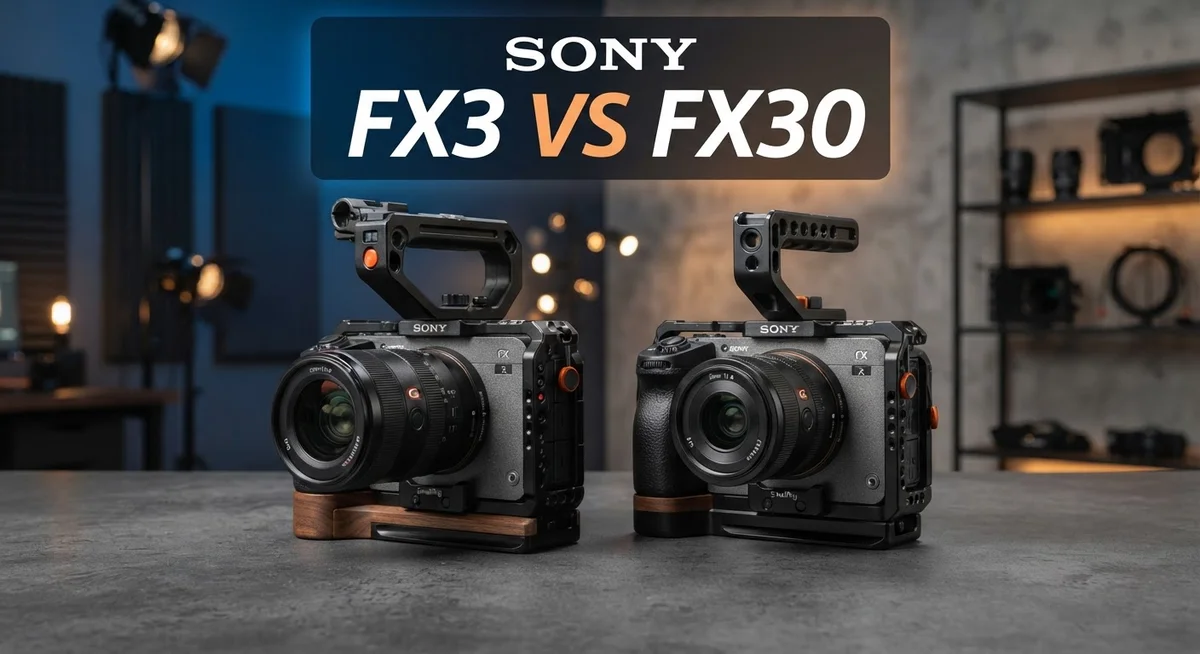
Sony FX3 vs FX30: Professional Cinema Camera Comparison
Picking a Sony cinema camera feels tricky. The FX3 and FX30 both look similar. But they differ in big ways.
The FX3 packs a full-frame sensor. It shines in low light. It handles tough shooting conditions with ease.
The FX30 uses an APS-C sensor. It offers higher resolution. It stays compact and easy to carry.
Both cameras share strong features. You get IBIS, Cine-EI mode, and ProRes RAW support. Both shoot smooth 4K and slow motion clips.
So which camera fits your work? This guide breaks down the real differences. We compare sensors, performance, and handling.
By the end, you will know which camera matches your style. Let’s explore the FX3 vs FX30 battle together.
In a Nutshell
Here is the quick summary for both cameras.
-
The FX3 uses a full-frame sensor. It gives you better low light shots. Noise stays low even in dark scenes.
-
The FX30 uses an APS-C sensor. It offers more resolution at 26MP. This helps when you need extra detail.
-
Both cameras share strong tools. You get IBIS, Cine-EI mode, and ProRes RAW support. LUT management works the same way on both.
-
The FX3 handles 4K 120fps without compromise. The FX30 struggles a bit here. Rolling shutter is also more visible on the FX30.
-
Autofocus and handling feel quick and easy on the FX30. It works well for fast paced shoots. The FX3 focuses more on raw image quality.
-
Think about your main need first. Choose the FX3 for low light and full frame depth. Choose the FX30 for portability and quick handling.
Your final pick depends on your shooting style and priorities.
Sensor and Image Quality
The sensor choice between these two cameras shapes everything you capture. The FX3 brings a full-frame 12.1MP sensor that excels in low-light scenes. This larger sensor gathers more light per pixel, which means cleaner footage when you shoot in dim conditions.
The FX30 uses a 26MP APS-C sensor that captures higher still image resolution. If you need to pull stills from your video, the extra megapixels give you more flexibility. The smaller sensor size also makes the camera more compact and easier to carry on long shoots.
Both cameras include in-body stabilization (IBIS), so handheld work feels smooth. They both support Cine-EI mode, which lets you adjust exposure in post-production without losing quality. This feature alone saves time in the editing suite.
Low-light performance favors the FX3 significantly. The full-frame sensor produces less noise when you push ISO higher. The FX3 also uses dual ISO ranges, which means you get two native sensitivity points instead of one. This dual setup prevents you from climbing the ISO ladder as aggressively.
The FX30 handles rolling shutter differently than the FX3. When you pan quickly or shoot moving subjects, the FX30 shows more distortion. The full-frame FX3 keeps lines straighter during fast motion. This matters if you shoot handheld action or fast-moving scenes regularly.
Dynamic range separates these sensors too. The full-frame FX3 preserves more shadow and highlight detail in a single shot. You have more room to grade in post-production without losing information.
Both cameras deliver 4K 120fps video, but the FX3 does it without compromise. The FX30’s 4K 120fps mode uses a crop, which tightens your field of view. If wide-angle work at high frame rates matters to you, the FX3 gives you the full sensor width.
Choose the FX3 for cinematic low-light work and maximum sensor capability. Pick the FX30 if you value portability and still image resolution equally with video performance.

- 20.1 MP Exmor R APS-C (Super 35mm format) image sensor with wide dynamic range
- S-CinetoneTM for a cinematic look straight out of the camera without grading

Last update on 2026-11-05 / Affiliate links / Images from Amazon Product Advertising API
Video Performance and Frame Rates
The frame rate capabilities of both cameras unlock different creative possibilities for your projects. The FX3 delivers 4K video at 120fps without any compromise to image quality or sensor readout. This means you capture ultra smooth slow motion footage that maintains full resolution and color depth. The full frame sensor processes all that data cleanly.
The FX30 also reaches 4K at 120fps, but the implementation differs. The camera uses a crop mode or reduced readout to achieve this frame rate. You still get excellent slow motion, though the full sensor area is not utilized. For most shooting scenarios, this remains highly functional.
Both cameras excel at 1080p recording. You can shoot Full HD at 240fps on either model. This opens up extreme slow motion options for action sequences, product reveals, or dramatic moments. The 1080p frame rates feel equally smooth on both systems.
The FX3’s full frame advantage shows up in frame rate flexibility. You get more options for sensor readout modes without quality loss. The camera handles high frame rates while maintaining the dynamic range and color science that cinema work demands.
Rolling shutter behavior changes between these two cameras at high frame rates. The FX30 exhibits more rolling shutter artifacts when panning quickly or capturing fast movement at 120fps. The APS-C sensor readout speed creates this limitation. The FX3’s full frame design minimizes this issue significantly.
Frame rate selection also affects your workflow. The FX3 lets you shoot 4K 120fps and still use the entire sensor width. You maintain consistent framing and perspective. The FX30 requires you to understand the crop implications when working at maximum frame rates.
For projects requiring extended high frame rate shooting, the FX3 proves more reliable. Your image remains consistent from shot to shot. The FX30 works beautifully for most projects, especially when you plan your frame rate strategy in advance.
Both cameras record to external media via HDMI, supporting ProRes RAW capture. This feature levels the playing field for color grading and post production flexibility.
Design, Portability, and Ergonomics
When you hold the FX3, you notice its full-frame body feels substantial and professional-grade. The camera sits heavier in your hands, which some shooters prefer for stability during long shoots. The FX30 takes a different approach with its compact APS-C design that weighs noticeably less.
Portability matters when you’re moving between locations. The FX30 wins here because it slides into bags more easily and causes less shoulder fatigue on all-day shoots. If you travel frequently or shoot run-and-gun style, the smaller form factor becomes a real advantage. The FX3 demands more space but gives you a camera that feels grounded and deliberate.
Both cameras feature the same control layout philosophy, so switching between them feels natural. The button placement and menu structure remain consistent across Sony’s cinema line. Your hands learn the interface quickly on either model.
Grip comfort separates these two cameras significantly. The FX3’s larger body provides more surface area for your fingers, which matters during handheld 4K work. The FX30’s compact grip requires slightly different hand positioning, but it never feels cramped or awkward. Many shooters actually prefer the FX30’s ergonomics for gimbal work because the lighter weight reduces motor strain.
In-body stabilization (IBIS) on both cameras means you can shoot handheld without external rigs. The FX3’s full-frame sensor combines with IBIS for smooth, cinematic handheld footage. The FX30 delivers similar stabilization performance, making it equally viable for handheld projects.
Weather sealing and build quality feel identical on both models. Sony equipped each camera with robust construction that handles professional environments. You get the same durability whether you choose full-frame or APS-C.
The real choice comes down to your typical shooting scenario. If you move constantly and need lightweight gear, the FX30 fits your workflow better. If you prefer a camera that feels solid in your hands and want the full-frame advantage, the FX3 suits your style. Neither camera compromises on build quality or handling feel.
Top 3 Alternatives
Panasonic Lumix S5

- A LIGHTWEIGHT, POWERFUL HYBRID CAMERA FOR VIBRANT STILL PHOTOGRAPHY AND CINEMATIC VIDEO: Realize...
Last update on 2026-11-05 / Affiliate links / Images from Amazon Product Advertising API
The Panasonic Lumix S5 offers full-frame capability without the compact design focus of Sony’s models. This camera excels at stills photography with a 24.2-megapixel sensor. You get excellent autofocus performance and reliable video recording at 4K resolution. The body feels comfortable in your hands during long shooting sessions. Battery life runs longer than many competitors, which matters for all-day work.
The lens ecosystem is smaller than Sony’s, but growing steadily. You’ll find quality glass from Panasonic and third-party manufacturers. The camera handles color grading well in post-production, giving you flexibility in your workflow.
Canon EOS R5

- High Image Quality: Canon EOS R5 8K digital camera features a stacked, back-side illuminated...
- Powerful Image Processor: DIGIC X image processor with an ISO range of 100-51200; expandable to...
Last update on 2026-11-05 / Affiliate links / Images from Amazon Product Advertising API
The Canon EOS R5 brings professional-grade features to serious creators. Its 45-megapixel sensor captures incredible detail for large prints and cropping. You get 8K video recording, which sets it apart from compact cinema cameras. The autofocus system tracks subjects reliably across the frame.
The body is larger and heavier, requiring sturdy support gear. Heat management becomes important during extended 8K recording sessions. Canon’s RF lens mount offers a vast selection of optics. The camera performs exceptionally well for both photography and videography combined.
Nikon Z6 III

- VIDEO - 6K/60p Internal N-RAW video recording + oversampled 4K UHD, 4K/120p, Full HD/240p slow...
- BEST IN CLASS EVF - Max brightness of 4000 nits gives a clear, vibrant view even in very bright...
Last update on 2026-11-05 / Affiliate links / Images from Amazon Product Advertising API
The Nikon Z6 III delivers balanced performance for hybrid shooters. Its 24.2-megapixel sensor matches the Sony FX30’s resolution closely. You get smooth 4K video with advanced stabilization built-in. The autofocus algorithm improves tracking of moving subjects effectively.
Nikon’s Z-mount ecosystem grows stronger each year. The camera body remains reasonably compact for its capabilities. Battery performance stands out compared to other mirrorless options. The ergonomic design suits both photographers and videographers equally well.
Autofocus and Workflow Efficiency
Autofocus performance shapes how quickly you can lock onto subjects and keep them sharp throughout your shoot. The FX30 delivers excellent autofocus tracking that responds fast to moving subjects. Its compact APS-C sensor helps the autofocus system work efficiently in most lighting conditions.
The FX3 uses full-frame autofocus technology that covers a wider area of the frame. This means you get more flexibility when your subject moves across the screen. The full-frame advantage lets you track subjects near the edges without reframing constantly.
Both cameras use Sony’s Fast Hybrid AF system, which combines phase-detection and contrast-detection autofocus. This hybrid approach gives you reliable performance whether you’re shooting stills or video. Real-world testing shows both cameras lock focus quickly in normal lighting.
Low-light autofocus differs between these two models. The FX3’s full-frame sensor captures more light, which helps autofocus work better in dim conditions. The FX30 still performs well indoors, but the FX3 maintains accuracy in darker environments more consistently.
For video workflow, autofocus speed matters significantly. The FX30 offers smooth focus transitions that feel natural on camera. The FX3 provides similar smoothness with slightly more precision when you need to pull focus manually.
Eye-tracking autofocus works on both cameras when you’re filming people. The FX3’s full-frame sensor sees a larger area, making eye-tracking more reliable when subjects move around. The FX30’s eye-tracking still works effectively for most interview and documentary work.
Your workflow efficiency depends on how often you need to adjust focus settings. The FX30 requires fewer manual adjustments because its autofocus stays locked more predictably. The FX3 gives you more control if you prefer manual focus pulling or need precision in critical shots.
Continuous autofocus during 4K 120fps recording handles differently on each camera. The FX30 maintains focus but processes it differently than the FX3. The FX3’s full-frame advantage shows up here with smoother continuous tracking at extreme frame rates.
Low-Light Performance and Dynamic Range
The FX3 and FX30 handle low-light situations quite differently due to their sensor designs. The FX3 uses a 12.1MP full-frame sensor, while the FX30 features a 26MP APS-C sensor. This fundamental difference shapes how each camera performs when light drops.
Full-frame sensors like the FX3’s capture more light per pixel. Larger pixels gather photons more effectively in dark environments. You’ll notice cleaner images with less visible noise when shooting at high ISOs. The FX3’s dual ISO range gives you two native sensitivity points. This means you can switch between them without introducing unnecessary noise.
The FX30’s smaller APS-C sensor has a tighter pixel density. More pixels in the same space means each one captures less light individually. However, the FX30 still performs admirably in low-light conditions. Sony’s processing algorithms help keep noise manageable across its ISO range.
Both cameras include Cine-EI mode, which lets you adjust exposure in post-production. This feature proves valuable when you’re working in challenging lighting. You can expose more conservatively during capture, then recover details later. The flexibility helps you preserve highlights and shadow detail simultaneously.
Dynamic range represents how many tones a camera can capture from dark to bright. The FX3’s full-frame advantage extends here too. Larger sensors typically deliver more dynamic range information. You get more separation between shadow and highlight detail. This extra information gives you greater control during color grading.
The FX30 still offers solid dynamic range for most projects. It handles mixed lighting situations reasonably well. You won’t feel limited unless you’re working with extreme contrast scenes.
Noise reduction behavior differs between these models. The FX3 applies less aggressive processing to its footage. This preserves fine details and texture. The FX30 uses more active noise reduction to maintain cleaner images at higher ISOs.
For cinematic work in dim environments, the FX3’s superiority becomes apparent. You’ll achieve cleaner, more detailed footage. The FX30 remains capable for many productions. Your choice depends on how often you shoot in challenging light and how much detail retention matters to your style.
Pros and Cons
Pros
- FX3: Full-frame sensor delivers superior 4K image quality with more light capture per pixel
- FX3: Dual ISO range gives you flexibility across extreme lighting conditions without switching modes
- FX30: Compact design fits easily into bags and works well for run-and-gun shooting
- FX30: APS-C sensor produces excellent autofocus performance and smooth handling in fast-paced work
- Both: Uncompromised 4K 120fps and 1080p 240fps let you capture slow-motion footage without limitations
Cons
- FX3: Higher investment compared to the FX30 impacts your total production budget
- FX30: 4K 120fps shows some frame rate compromises you’ll notice in demanding situations
- FX30: Smaller APS-C sensor experiences worse rolling shutter than the full-frame FX3 during fast pans
- FX30: Dynamic range falls short when compared to higher-end cinema cameras like RED systems
Who Should Buy It
The FX3 works best for professionals who prioritize image quality above all else. If you shoot narrative films, commercials, or high-end documentaries, the full-frame sensor gives you that cinematic look you need. The superior low-light performance means you can work in challenging lighting without excessive noise. The dual ISO range is a game-changer when you’re dealing with extreme brightness swings on set.
Choose the FX3 if you want uncompromised 4K 120fps for slow-motion sequences without frame rate drops. You’ll also appreciate the less aggressive noise reduction, which gives you more control in post-production. This camera suits cinematographers who value maximum creative flexibility and don’t mind the heavier workflow.
The FX30 is your camera if you’re constantly on the move. Content creators, vloggers, and journalists love its compact design. You can grab it quickly and start filming without overthinking setup. The APS-C sensor delivers excellent autofocus performance, making it ideal for fast-paced interviews and breaking news situations.
Pick the FX30 if you shoot mostly in controlled lighting or outdoors during daylight hours. The higher still resolution (26MP) helps when you need to pull frames from video or crop heavily. Your workflow becomes smoother because the camera handles everyday shooting scenarios effortlessly. The quick autofocus means less time fussing with manual focus adjustments during takes.
Both cameras suit creators who use Cine-EI mode regularly. If you plan to grade footage extensively in post-production, either option works well. Choose based on your primary shooting style: the FX3 for quality-focused, controlled productions, and the FX30 for mobility and quick turnaround projects.
Your choice ultimately depends on whether you prioritize maximum image quality or portability. The FX3 rewards patient cinematographers working on substantial productions. The FX30 rewards adaptable creators who need speed and simplicity. Neither camera disappoints for professional video work.
Final Verdict
Choosing between the Sony FX3 and FX30 comes down to your shooting style. Both cameras share a lot of features. But your final decision should match your creative goals, not just specs on paper.
If you shoot narrative films, documentaries, or events with unpredictable lighting, the FX3 fits your needs. Its full-frame sensor handles tough scenes with confidence. This camera rewards filmmakers who plan shoots carefully and want maximum flexibility later.
The FX30 suits creators who move fast and shoot often. Wedding videographers, vloggers, and solo content creators benefit from its compact body. You get quick setup and reliable results without extra bulk.
Think about your existing lens collection too. If you already own full-frame E-mount glass, the FX3 makes more sense. If you use APS-C lenses or plan to build a lighter kit, the FX30 pairs naturally with that setup.
Consider your growth as a creator as well. Professionals working with clients who expect top-tier deliverables often lean toward the FX3. Freelancers building a diverse portfolio might prefer the FX30’s flexibility across different project types.
Competitors like the Sony A7 IV or ZV-E1 offer alternative paths if you want different sensor sizes or features. The Fujifilm X-S20 and Nikon ZR are worth exploring too if you’re open to switching brands entirely.
Neither camera is a wrong choice. Both deliver strong cinema quality footage and share core video tools like Cine-EI mode and ProRes RAW support.
Your final call depends on daily shooting habits. Ask yourself where you shoot most often and what limitations frustrate you today.
Match the camera to your workflow, not the other way around. That approach leads to better results on set and happier clients in the long run.
Frequently Asked Questions
Which camera handles low light better?
The FX3 excels in dim environments. Its full-frame sensor captures more light per pixel than the FX30’s APS-C design. The FX3 also uses a dual ISO range that lets you shoot cleanly in extreme darkness without aggressive noise reduction destroying detail.
The FX30 performs well indoors and in studios, but struggles more when you push sensitivity to maximum levels.
Can I use the same lenses on both cameras?
No. The FX3 uses Sony E-mount lenses designed for full-frame bodies. The FX30 also uses E-mount, but it’s optimized for APS-C (Super 35) format.
You can physically attach full-frame lenses to the FX30, but they’ll crop tighter. You’ll lose your wide-angle coverage. Investing in APS-C lenses for the FX30 makes more sense long-term.
Which one gives sharper autofocus?
The FX30 wins here. Its APS-C sensor delivers superior autofocus tracking and faster subject acquisition. The camera locks onto moving subjects quicker, making it ideal for fast-paced work.
The FX3 has reliable autofocus too, but the FX30’s design makes it slightly snappier for video work.
Does rolling shutter matter for my shoots?
Yes, if you pan cameras quickly or shoot action sequences. The FX3 has cleaner rolling shutter performance. The FX30 shows more distortion when you move the camera fast horizontally.
For static shots or slow movements, both cameras perform identically. Rolling shutter only becomes noticeable during rapid motion.
Which sensor gives more still image resolution?
The FX30 captures 26MP stills. The FX3 records 12.1MP images. If you need high-resolution photographs alongside video work, the FX30 pulls ahead significantly.
However, for video-first creators, this difference barely matters. Both cameras deliver stunning 4K footage.

Dillip is the founder and editor of ImageScaleLab.com, a passionate tech enthusiast who loves breaking down complex gadgets and accessories into simple, honest reviews and buying guides. With years of hands-on experience exploring the latest in tech, he is dedicated to helping readers make smarter, more confident purchasing decisions.