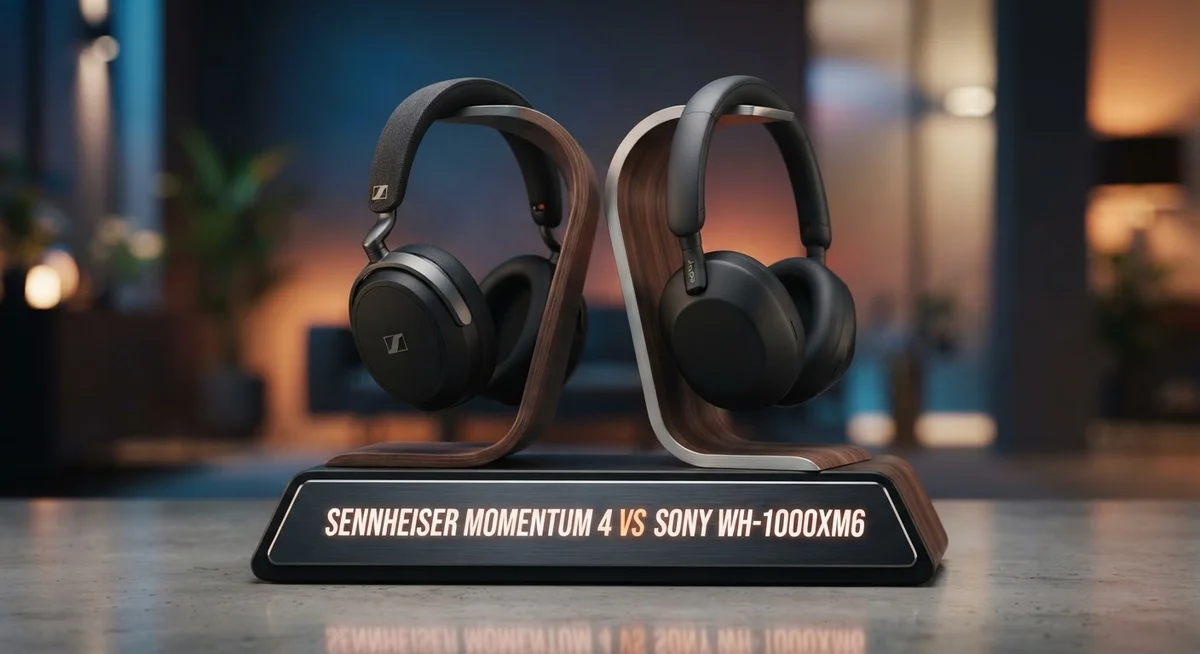
Sennheiser Momentum 4 vs Sony WH-1000XM6: Complete Headphones Comparison
Picking a new pair of headphones can feel tricky. Two names often top the list: Sennheiser Momentum 4 and Sony WH-1000XM6.
Both models promise great sound and smart features. But they take different paths to get there.
The Momentum 4 focuses on long battery life and rich audio quality. It suits listeners who want less charging and more listening.
The XM6 shines with superior noise cancellation and a lighter fit. It also brings spatial audio and a sharper microphone system for calls.
So which one fits your daily routine? This guide breaks down every key difference. We compare battery life, sound quality, comfort, and smart features side by side.
By the end, you will know exactly which headphones match your lifestyle. Let’s dive into the details and find your perfect pair.
In a Nutshell
Here is the quick lowdown on both headphones before you decide:
- Battery life clearly favors the Momentum 4. It runs for hours longer than the XM6 on a single charge.
- The XM6 wins on connectivity. It supports Bluetooth 5.3 and LDAC for richer wireless streaming.
- Spatial audio comes only with the XM6. This adds an immersive layer to movies and music.
- Sound clarity leans toward the Momentum 4, thanks to its wider frequency range.
- The XM6 offers better microphones. Calls sound clearer and background noise gets filtered well.
- Comfort goes to the XM6 too. Its lighter build feels easier on your head during long sessions.
- Both models struggle a bit with transparency mode. Neither delivers a truly natural outside sound experience.
In short, pick the Momentum 4 if battery life and sound quality matter most to you. Choose the XM6 if you want sharper noise cancellation, spatial audio, and a lighter fit for daily wear.
Battery Life and Endurance
The battery endurance story separates these two headphones in a meaningful way. The Momentum 4 dominates with 40 to 60 hours of playback on a single charge. This means you can go weeks without plugging in your headphones.
The XM6 delivers 30 to 40 hours instead. While still impressive, this gap matters if you travel frequently or forget to charge often. Most people will need to charge the Sony model roughly twice as often as the Sennheiser.
Real world usage tells an interesting story. Heavy listeners get roughly two weeks of music from the Momentum 4 before hunting for a charger. The XM6 users typically need to recharge every 5 to 7 days with moderate use.
Charging speed differs between these models. The Momentum 4 uses a standard USB connection that charges slowly but reliably. The XM6 supports faster charging, so you can grab a quick 10 minute top up when needed.
Daily commuters see real benefits from the Momentum 4’s endurance. A 90 minute flight or a week of gym sessions won’t drain the battery completely. The XM6 handles these tasks fine too, but you’ll notice the difference during longer trips.
Weekend warriors and casual listeners find both options work well. If you charge your headphones every few days anyway, the XM6’s battery feels perfectly adequate. Heavy users who skip charging for weeks will appreciate the Momentum 4 far more.
The weight factor plays into endurance too. The XM6 feels lighter on your head, which reduces fatigue during long listening sessions. The Momentum 4 weighs more but still feels comfortable for most people wearing them all day.
Battery anxiety disappears with the Momentum 4. You simply forget about charging because the headphones last so long. The XM6 requires more attention to battery levels, especially before travel or outdoor activities.
Bottom line: Choose the Momentum 4 if you hate charging frequently. Pick the XM6 if you prefer lighter weight and don’t mind charging every week.

- Compatible Models: Headband protective cover compatible with Bose QuietComfort Ultra 1st & 2nd Gen...
- Fit for Marshall Major 5/4/3/2, for Anker Soundcore Space 2, Space One, Space One Pro, for Jabra...
Last update on 2026-11-10 / Affiliate links / Images from Amazon Product Advertising API
Active Noise Cancellation and Sound Quality
Active noise cancellation separates these two headphones in meaningful ways. The XM6 delivers superior ANC performance across most listening environments. Sony’s system cancels ambient noise more effectively during flights, commutes, and busy offices. The Momentum 4 offers decent noise blocking, but it falls short compared to Sony’s advanced algorithm.
Sound quality tells a different story. The Momentum 4 produces richer, warmer audio with its extended frequency range starting at 4 Hz. This lower baseline captures deeper bass notes and fuller midrange tones. The XM6 begins at 6 Hz, which means you lose some of those low frequency details. If you love bass heavy music or podcasts with crisp vocals, the Momentum 4 wins here.
The XM6 brings spatial audio to the table. This feature creates a 3D sound experience when watching movies or gaming. The Momentum 4 lacks this capability entirely. For entertainment focused listeners, spatial audio makes a real difference in immersion.
Transparency mode matters for staying aware of your surroundings. Both headphones struggle slightly in this area. Neither model excels at letting outside sounds pass through naturally. You will hear some artificial quality when using transparency on either pair. This is a minor weakness for both, so neither has an advantage.
Real world listening reveals nuanced differences. The XM6 shines when you need maximum isolation from noise. Its microphone system also captures your voice more clearly during calls. The Momentum 4 excels when you prioritize audio fidelity and want to hear every detail in your music.
Choose the XM6 if noise cancellation ranks at the top of your priorities. Choose the Momentum 4 if sound quality and frequency response matter more. Your daily environment determines which strength serves you better. Frequent travelers and office workers benefit from the XM6’s ANC. Audiophiles and music lovers lean toward the Momentum 4’s sound signature.
Comfort, Design, and Portability
The Sennheiser Momentum 4 features a more robust build with larger ear cups and a sturdier headband. This design prioritizes durability over sleekness. The padding feels generous, making extended listening sessions comfortable for most head shapes.
The Sony WH-1000XM6 takes a different approach with a slimmer profile and lighter construction. Sony engineered these headphones to feel almost weightless on your head. The ear cups swivel and fold more compactly than the Momentum 4.
When it comes to weight, the XM6 wins decisively. Lighter headphones reduce ear fatigue during long wear periods. The Momentum 4 feels heavier but many users appreciate the solid feel. It signals quality through its heft.
Portability matters if you travel frequently. The XM6 folds into a more compact shape and fits easily into bags or backpacks. The Momentum 4’s larger frame means it takes up more space. However, both models include carrying cases for protection.
The headband design differs significantly between these two. The Momentum 4 uses a fixed headband with soft padding underneath. The XM6 features an adjustable headband that adapts to different head sizes more flexibly. This adjustment mechanism on the XM6 helps distribute weight more evenly.
Ear cup comfort depends on personal preference. Some people prefer the Momentum 4’s deeper cups, which isolate sound better. Others find the XM6’s shallower design more comfortable for extended wear. The XM6’s softer padding feels gentler on the ears during long sessions.
The XM6 edges ahead for all day comfort thanks to its lighter weight and thoughtful padding. Your ears won’t feel sore after wearing them for eight hours straight. The Momentum 4 works well too, but the extra weight becomes noticeable after several hours.
For travel, the XM6 packs down smaller and weighs less in your luggage. The Momentum 4 requires more space but offers superior durability if you toss your headphones around carelessly.
Bottom line: Choose the XM6 if comfort and portability rank high on your list. Pick the Momentum 4 if you want a sturdy, long lasting design that feels premium in your hands.
Top 3 Alternatives
Bose QuietComfort Ultra

- BREAKTHROUGH SPATIALIZED AUDIO: Super immersive sound spatializes everything, taking the music out...
- NOISE CANCELLING HEADPHONES: Enjoy Bose’s best noise cancellation for headphones with Quiet Mode...

Last update on 2026-11-10 / Affiliate links / Images from Amazon Product Advertising API
The Bose QuietComfort Ultra stands out with industry-leading noise cancellation that rivals both competitors. You get a comfortable fit designed for all-day wear, and the sound quality delivers crisp highs and deep lows. Battery life reaches up to 24 hours, which beats most alternatives. The microphone picks up your voice clearly during calls. These headphones work seamlessly with both Android and iOS devices.
Apple AirPods Max

- ULTIMATE OVER-EAR LISTENING EXPERIENCE—Powered by the H2 chip, AirPods Max 2 delivers improved...
- TUNE OUT THE NOISE—Up to 1.5x more Active Noise Cancellation than the previous generation, fully...
Last update on 2026-11-10 / Affiliate links / Images from Amazon Product Advertising API
Apple AirPods Max offer spatial audio technology that creates an immersive listening experience. The design feels premium with a stainless steel frame and soft ear cushions. You’ll enjoy seamless integration if you use Apple devices like iPhones or MacBooks. The headphones provide active noise cancellation and transparency mode. Battery life lasts around 20 hours per charge. These headphones support lossless audio when connected to compatible Apple devices.
JBL Tour One M2

- The wireless Tour One M2 Bluetooth headphones with impressive JBL Pro Sound isolate noise thanks to...
- The JBL Spatial Sound delivers a spatial sound experience while the Personi-Fi function allows the...
Last update on 2026-11-10 / Affiliate links / Images from Amazon Product Advertising API
The JBL Tour One M2 delivers powerful bass and vibrant sound that appeals to music lovers. Adaptive noise cancellation adjusts to your environment automatically. The headphones include a carrying case and offer around 50 hours of battery life with the case. You get touch controls on the ear cups for easy navigation. These headphones work well with both Android and Apple devices. The build quality feels sturdy, and the fit remains comfortable during extended listening sessions.
All three options provide excellent alternatives to the Sennheiser Momentum 4 and Sony WH-1000XM6. Each brings unique strengths, whether you prioritize noise cancellation, audio quality, or battery life.
Connectivity and Advanced Features
The Sennheiser Momentum 4 and Sony WH-1000XM6 take different approaches to modern wireless connectivity. The XM6 includes Bluetooth 5.3 with LDAC codec support. This means you get higher quality audio streaming from compatible devices. The Momentum 4 uses standard Bluetooth connectivity without LDAC.
For streaming music, the XM6’s codec advantage matters if your phone supports it. You’ll notice cleaner audio on services like Tidal or high-resolution sources. The Momentum 4 handles everyday streaming just fine through standard Bluetooth protocols.
Spatial audio support separates these models significantly. The XM6 delivers immersive 3D sound when watching movies or gaming on compatible platforms. The Momentum 4 does not include spatial audio features. If you watch content on Netflix or Disney Plus frequently, the XM6 creates a more engaging experience.
Both headphones connect easily to multiple devices. You can pair them with your phone, laptop, and tablet without hassle. Switching between devices happens smoothly on both models.
The microphone systems differ in capability. The XM6 features a superior microphone array for clearer calls and voice commands. The Momentum 4’s microphone works for basic calls but lacks the same precision. If video conferencing matters to you, the XM6 handles background noise better during calls.
App connectivity enhances both experiences. The Sony Headphones Connect app and Sennheiser Momentum app let you customize settings. You can adjust EQ, ANC levels, and check battery status through either app. Both apps function smoothly on Android and iOS.
Real world usage shows the XM6 excels for tech enthusiasts wanting premium features. Spatial audio, LDAC support, and superior microphone quality appeal to content creators and audiophiles. The Momentum 4 prioritizes straightforward connectivity without extra complexity. Choose the XM6 if you want cutting edge wireless features and enhanced audio technology. Pick the Momentum 4 if simple, reliable connectivity suits your lifestyle better.
Microphone Quality and Call Performance
The microphone quality on both headphones handles calls differently. The Sony WH-1000XM6 features a superior microphone system that captures your voice with impressive clarity. You’ll sound crisp and natural during video conferences and phone calls.
The Sennheiser Momentum 4 uses a decent microphone setup. It works fine for casual calls, but the Sony edges ahead for professional settings where voice quality matters most.
Wind noise handling differs between these two models. The XM6’s microphone design reduces background wind interference better than the Momentum 4. If you take calls outdoors frequently, this matters more than you might think.
Call stability remains solid on both devices. Neither headphone drops connections during calls, and both maintain reliable Bluetooth performance throughout your conversations. The connection stays steady whether you’re in an office or moving around your home.
Background noise suppression is where the XM6 truly shines. Its microphone system filters out keyboard clicks, traffic sounds, and office chatter more effectively. The Momentum 4 captures more ambient noise, which can distract people listening to you.
Echo cancellation works well on both models. Your call recipients won’t hear their own voice bouncing back. This feature prevents that annoying feedback loop that ruins conversations.
For video calls specifically, the XM6 delivers better overall call performance. The microphone captures your voice naturally without sounding thin or distant. Video conferencing apps like Teams, Zoom, and Google Meet benefit from this superior microphone quality.
The Momentum 4 handles calls adequately for everyday use. Casual phone conversations sound fine, and your contacts won’t complain about audio quality. However, if you spend your day on video calls, the XM6 provides noticeably better performance.
Choose the Sony WH-1000XM6 if you make frequent professional calls or spend significant time in video meetings. The microphone system justifies this choice for work-from-home professionals and business travelers. The Momentum 4 works well for occasional calls, but the XM6 simply performs better when call quality is your priority.
Pros and Cons
Pros
- Momentum 4: Battery lasts 40 to 60 hours, so you skip charging for weeks
- Momentum 4: Sound quality delivers rich, detailed audio across music genres
- XM6: Active noise cancellation blocks more ambient sound than the Momentum 4
- XM6: Lighter weight reduces fatigue during extended listening sessions
- XM6: Spatial audio creates immersive 3D sound for compatible content
Cons
- Momentum 4: Noise cancellation feels weaker compared to Sony’s technology
- XM6: Battery runs out faster at 30 to 40 hours per charge
- Both models: Transparency mode sounds mediocre when you want to hear surroundings
- Momentum 4: Missing spatial audio limits immersion with newer streaming services
Who Should Buy It
Choose the Sennheiser Momentum 4 if you prioritize marathon listening sessions. You travel frequently and need headphones that survive a week without charging. Your commute involves long flights or road trips where outlets are scarce. You value rich, detailed sound quality and don’t mind slightly weaker noise cancellation in exchange for superior audio clarity.
The Momentum 4 suits music lovers who spend hours discovering new albums. You listen in quieter environments where active noise cancellation matters less. You want comfort during extended wear without worrying about battery anxiety.
Pick the Sony WH-1000XM6 if you live in noisy urban environments. You ride public transit, work in open offices, or travel through busy airports regularly. Superior active noise cancellation becomes essential for your daily routine. You need the best microphone system for professional calls and video meetings.
The XM6 fits professionals who juggle frequent video conferences. You appreciate lighter headphones that feel less heavy after hours of wearing them. You stream music on devices that support spatial audio and want that immersive 3D experience. You spend money on premium tech gadgets and expect cutting edge features.
Consider your lifestyle honestly. Do you charge devices daily anyway? The XM6’s 30 to 40 hour battery feels normal then. Do you forget chargers at home? The Momentum 4’s 40 to 60 hour endurance prevents dead headphones mid week.
Think about your noise environment too. Silent home offices and quiet libraries mean the Momentum 4 works fine. Subway commutes and open office spaces demand the XM6’s stronger noise blocking.
Your call frequency matters significantly. Quick phone calls work on both models. Daily video meetings and professional client calls? The XM6 handles these better with its superior microphone system and background noise suppression.
Neither choice is wrong. Both deliver solid wireless headphone experiences. The Momentum 4 wins for battery endurance and sound quality. The XM6 wins for noise cancellation, comfort, and call performance. Match your actual daily habits to the right headphone, and you’ll feel satisfied with your decision.
Final Verdict
Choosing between these two headphones comes down to your daily habits. Both models excel in different areas, and neither one is a bad choice.
The Sennheiser Momentum 4 shines for people who value sound and endurance. If you want a headphone that lasts through long trips without a charger nearby, this one delivers.
The Sony WH-1000XM6 stands out for people who deal with noise every day. Commuters, office workers, and frequent callers benefit most from its advanced features.
Think about where you spend most of your time. A quiet home office favors the Momentum 4. A busy city commute favors the XM6.
Your priorities matter more than any spec sheet. Some buyers care deeply about audio richness. Others care more about blocking out chaos around them.
Comfort during long sessions also plays a role in this decision. The XM6 feels lighter on your head, which helps during marathon workdays. The Momentum 4 still offers solid comfort but does not match Sony’s ergonomic edge.
If you attend calls often, lean toward the XM6. Its microphone system and noise handling make virtual meetings smoother. The Momentum 4 works fine for casual calls but falls short for professional use.
For pure music enjoyment, the Momentum 4 has an advantage. Its sound signature feels more natural and detailed across genres. Audiophiles will likely notice this difference right away.
There is no universal winner here. Your lifestyle decides which headphone fits better. Assess your daily routine honestly before making a final choice.
Do you travel often and need long battery life? Pick the Momentum 4. Do you live in a noisy environment and need strong isolation? Pick the XM6.
Either way, you get a reliable pair of headphones built for real world use. Match the features to your needs, and you will feel satisfied with your choice.
Frequently Asked Questions
Which headphones have better battery life?
The Sennheiser Momentum 4 wins here with 40 to 60 hours per charge. The Sony WH-1000XM6 delivers 30 to 40 hours. If you travel frequently or forget to charge often, the Momentum 4 keeps playing much longer.
Do the Sony headphones sound better?
Both deliver excellent audio, but they differ in approach. The Sony WH-1000XM6 adds spatial audio, which creates immersive 3D sound for compatible movies and shows. The Momentum 4 focuses on pure music quality with rich, detailed sound across all genres.
Your choice depends on what you watch and listen to most.
Which has stronger noise cancellation?
The Sony WH-1000XM6 blocks more ambient sound overall. Its active noise cancellation technology outperforms the Momentum 4 in busy environments like trains, offices, and airports.
The Momentum 4’s ANC feels adequate for quiet spaces but struggles in noisy settings.
Are these headphones comfortable for all day wear?
The Sony WH-1000XM6 weighs less, which reduces ear and head fatigue during extended sessions. The Momentum 4 feels heavier but many users find it comfortable anyway.
Test both if possible, since comfort varies by head shape and ear size.
Which one works better for video calls?
The Sony WH-1000XM6 has a superior microphone system that captures your voice clearly during conferences and calls. The Momentum 4’s mic works fine for casual conversations but sounds less crisp on professional calls.
If you attend frequent video meetings, the XM6 makes a real difference.

Dillip is the founder and editor of ImageScaleLab.com, a passionate tech enthusiast who loves breaking down complex gadgets and accessories into simple, honest reviews and buying guides. With years of hands-on experience exploring the latest in tech, he is dedicated to helping readers make smarter, more confident purchasing decisions.